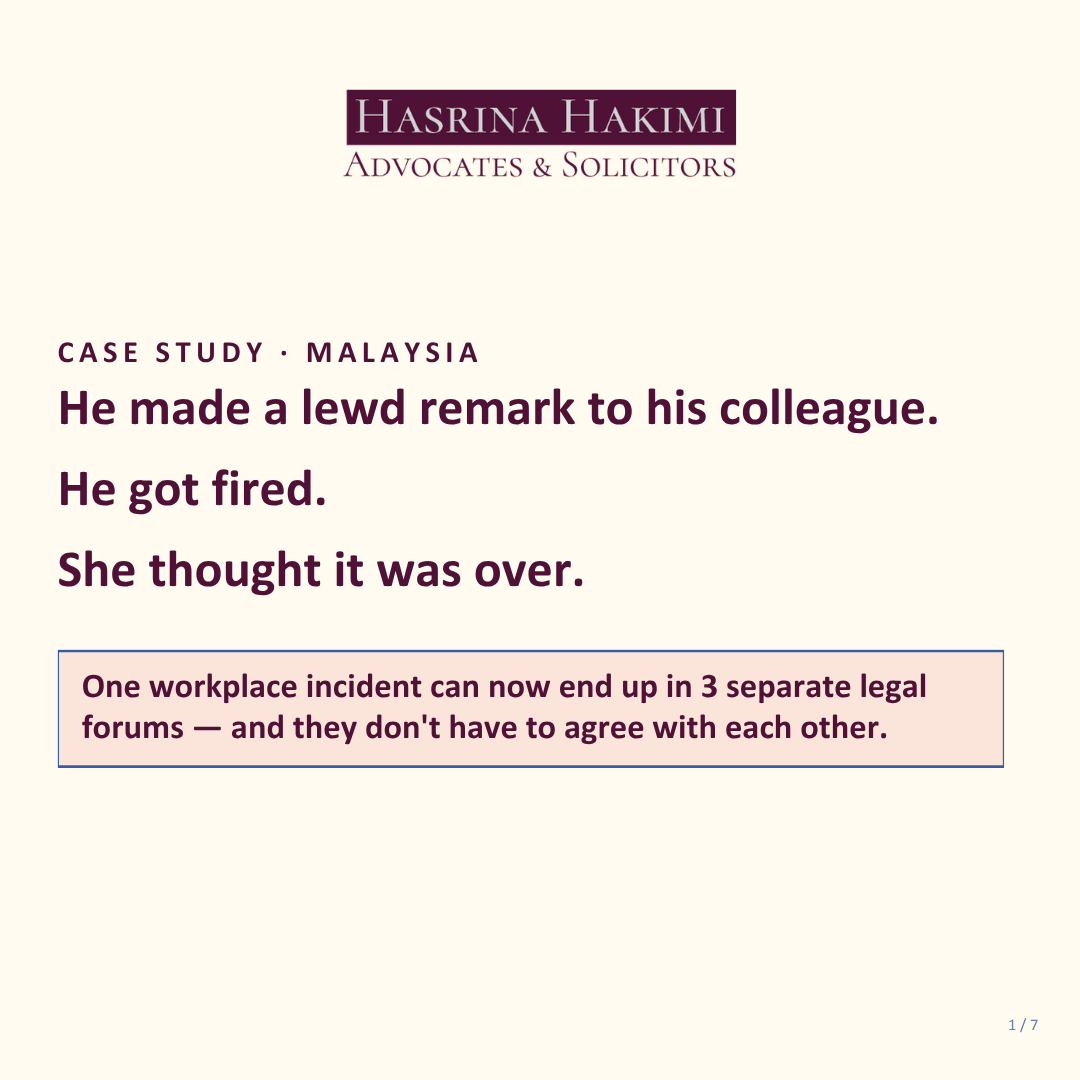

The case of Eurofins GSC IT Malaysia serves as a landmark illustration of how sexual harassment in the Malaysian workplace is dealt with under the Industrial Court. The dispute centered on an IT Engineer who was dismissed for insubordination as well as sexual harassment by making a lewd comment to his single female Team Lead, suggesting her COVID-19 infection was the result of her “making out.” This article will focus on the sexual harassment claim.
While the Industrial Court ultimately upheld the dismissal—noting the claimant’s evasive testimony and the inherently offensive nature of his remark—the case highlighted a growing systemic issue.
Parallel to the internal disciplinary action, a complaint had been lodged with the Labour Office. There is nothing on record to state if the female Team Lead victim had lodged a complaint to the Tribunal for Anti-Sexual Harassment (TAGS).
The Institutional Gap
Following the enactment of the Anti-Sexual Harassment Act 2022, victims now have a dedicated specialist forum; TAGS. However, this creates a fragmented system where two different bodies mayadjudicate the exact same set of facts in total isolation:
- The Industrial Court: Focuses on whether a dismissal was with “just cause and excuse.” It is envisaged that in this situation, the harasser had been terminated by the company and who then filed a complaint for unfair dismissal.
- TAGS: Focuses on victim compensation and determining if harassment occurred under the Act. It is envisaged that in this situation, the victim lodges a complaint to TAGS directly against the harasser (whether dismissed or otherwise from employment by the company) without the company’s involvement.
The Risk of Inconsistency
Currently, there is no legal requirement for these forums to communicate. This lack of integration may create some risk of irreconcilable outcomes. For instance, TAGS could find that no harassment occurred, while the Industrial Court upholds a dismissal for that very same conduct. Conversely, TAGS could award compensation to a victim, while the Industrial Court orders the harasser to be reinstated, forcing the victim to work alongside their perpetrator once again. Such a scenario is not only legally awkward but institutionally indefensible.
Part 2: Bridging the Gap—A Path Toward Coordination
The Evidentiary Cross-Pollination
If TAGS finds that sexual harassment occurred, is that finding of fact admissible in Industrial Court proceedings involving the same conduct? And if the Industrial Court reaches a contrary conclusion, can the dismissed employee rely on that in the TAGS proceedings?
There is no reported Malaysian authority addressing the cross-admissibility of findings between TAGS and the Industrial Court although there doesn’t seem to be any barrier to the evidence that each party can bring in those proceedings.
The Burden on the Complainant
The person most disadvantaged by this fragmentation is the victim. To be involved in two separate forums, the victim may find it cumbersome and exhausting. Although a victim has no “standing” or right to be heard in the Industrial Court (which is a dispute strictly between the employer and the ex-employee), the victim may tell his or her story when called as a witness. In such circumstance, both company and victim must work together to achieve a favourable decision. If the Industrial Court orders reinstatement of the harasser, although unlikely if the sexual harassment is proven, the victim has no standing to appeal but the responsibility lies on the company. If the victim chooses TAGS, he or she must accept that any compensation award however appropriate, cannot prevent reinstatement.
Proposed Solutions: Disclosure, Sequencing, and Admissibility
To prevent the legal system from working against itself, three minimum reforms are necessary:
- Sharing or Disclosure: Both TAGS and the Industrial Court should establish a coordination team on both sides to notify each other if parallel proceedings are active regarding the same incident.
- Stay of Proceedings pending outcome: Where two cases are active, one forum should ideally hold its findings in abeyance until the first-engaged tribunal has reached a decision, ensuring visibility of the initial outcome. As TAGS claim that it will come to its decision within 60 days from the date of hearing, it is most likely that TAGS’ decision will be known first. Industrial court proceedings is known to take far longer than that.
- Admissibility of Findings: Factual determinations made by TAGS (as a specialist body) should be admissible as evidence in Industrial Court proceedings. The Industrial Court should allow the specialist tribunal’s findings in the determination of the facts in issue.
Conclusion
The Eurofins GSC IT Malaysia award is, on its own terms, a careful and principled application of established doctrines. Witness credibility was rigorously assessed and proportionality was properly applied. The outcome is defensible on the facts but questions linger – what is the legal relationship between the two forums the legislature has created, and what happens when they disagree?
The Anti-Sexual Harassment Act 2022 was enacted to give victims a dedicated forum with specialist jurisdiction and meaningful compensation remedies. What is explicitly clear is that there is now an overlap of jurisdiction as to the victim’s sexual harassment. Practitioners advising both complainants and employers must understand that a workplace sexual harassment incident may now generate proceedings in three separate forums; the employer’s internal inquiry, TAGS, and the Industrial Court- each capable of reaching independent conclusions on whether the same conduct constitute sexual harassment. The victim, or the harassed person, bears the greatest burden of any incoherence.
This author referred to the LinkedIn post by Tahirah Manesah binti Abu Bakar on the same case in the preparation for this article.