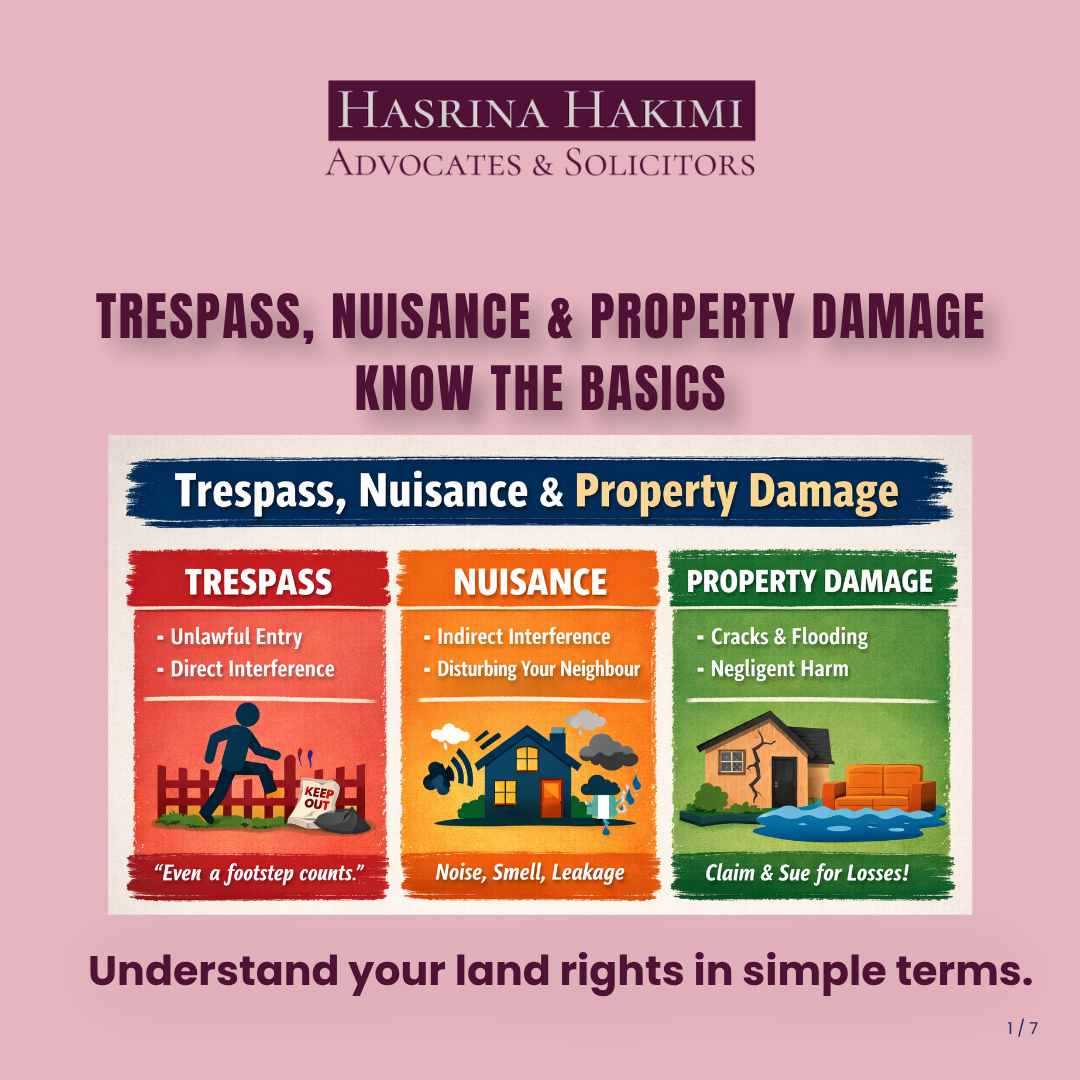

- Trespass to land
Trespass happens when someone enters or interferes with another person’s land without permission or lawful reason. A landowner has the right to enjoy and use their land exclusively. This is reflected in section 44(1) of the National Land Code, which gives a registered landowner the right to the exclusive use and enjoyment of the land, including the airspace above it and the land below it, so far as reasonably necessary.
Trespass does not require proof of actual damage. Even a small unlawful entry is enough. As stated by Coleridge CJ in Ellis v Loftus Iron Co (1874) LR 10 CP 10 at p 12:
“… if the defendant place a part of his foot on the plaintiff’s land unlawfully, it is in law as much a trespass as if he had walked half a mile on it.”
This means that a person can sue for trespass even if nothing was physically damaged. If damage is proven, the Court may award compensation. If the trespasser used the land for his own benefit, the Court may also award a reasonable sum for that use.
2. Nuisance
Nuisance is different from trespass. It usually happens when a person does something on their own land, but the effect of that act interferes with a neighbour’s land. Examples include noise, smell, smoke, vibration, water leakage, sewage overflow, soil erosion or anything else that affects another person’s use or enjoyment of land.
A nuisance may arise where the defendant’s act:
- causes something to encroach onto the neighbour’s land;
- causes physical damage to the neighbour’s land or building; or
- affects the neighbour’s comfort and enjoyment of the land.
This is similar to the leading case of Rylands v Fletcher (1868) LR 3 HL 330:
- a person who accumulates a substance on their land that is likely to do mischief if it escapes,
- the accumulation being a non-natural use of the land,
- and it does escape,
- they are liable for damage resulting from the escape.
*Essentially, for nuisance, there must be proof of damage for nuisance. If no damage / loss is suffered, there can be no liability.
In nuisance, the claimant usually has to show actual interference or damage.
A useful example is Chin Moy Yen v Chai Weng Sing [2019] MLJU 681, where the complaint concerned renovation works, noise, cracks, water leakage, sewage smell and sewage overflow. The Court found that this was not a mere inconvenience. The nuisance had gone beyond what a person should reasonably be expected to tolerate:
“[89] … The appellantsʼ complaints were not imagined but were real; the noise and nuisance created not just by the renovations [as seen from the contractorsʼ own police reports] but by the residents in the three penthouse units were of such volume, intensity, persistence or regularity [as can be seen from the almost regular police reports made by all parties] that any reasonable standard will consider such conduct and acts complained of, a nuisance. The matters complained of by the appellants were not mere irritation or hyper sensitivity to the respondentsʼ acts or conduct, but acts of nuisance which had traversed beyond lines of tolerance and decency; especially when regard is given to the type of residence that Flora Green Condominiums is supposed to be. Those acts or conduct had breached the principle of reasonableness or reasonable user and had interfered with the appellantsʼ reasonable enjoyment of their property, their home.”
3. Property damage
Property damage is usually not a separate claim on its own. It is normally the result of another wrongful act, such as trespass, nuisance or negligence.
For example, if a neighbour’s construction works cause cracks to your wall, flooding to your land or damage to your drainage system, the claim may be framed as nuisance, negligence, trespass, or a combination of these claims.
4. Difference between trespass and nuisance
Imagine, your neighbour is renovating his house. If his contractor enters your compound to keep cement bags or put up scaffolding, that is trespass. If the contractor stays inside your neighbour’s house, but the renovation causes dust, noise, cracks or water leakage in your house, that is nuisance.
This difference was explained in Petronas Gas Bhd v Dwz Industries (Johor) Sdn Bhd & Anor [2021] 7 MLJ 283:
“[44] Clerk & Lindsell on Torts (17th Ed) at p 909 explains the distinction between trespass and nuisance as follows:
Trespass is a direct entry on the land of another, and is actionable per se, without proof of special damage, but nuisance is the infringement of the plaintiff’s interest of the property without direct entry by the Defendant, and generally actionable only on proof of special damage. For example, to build a wall partly on the land of another is a trespass, but to build on one’s own land a wall which, through disrepair, falls on to another’s land is nuisance. It is a trespass for A directly to discharge water on to B’s land, but if water spills from A’s land over intermediate land be onto B’s land this amount to a nuisance. Such a distinction may be on certain facts an exceeding fine one. But the distinction will not normally become vital to the plaintiff’s claim where he can allege and prove special entry by way of trespass. It is a nuisance and not a trespass if the branches of a tree, whether planted or self-sown, growing on the land of one man.
[45] Given that the defendants have been found liable on trespass which is actionable per se without proof of special damage, this head of claim is at best, in the alternative.”