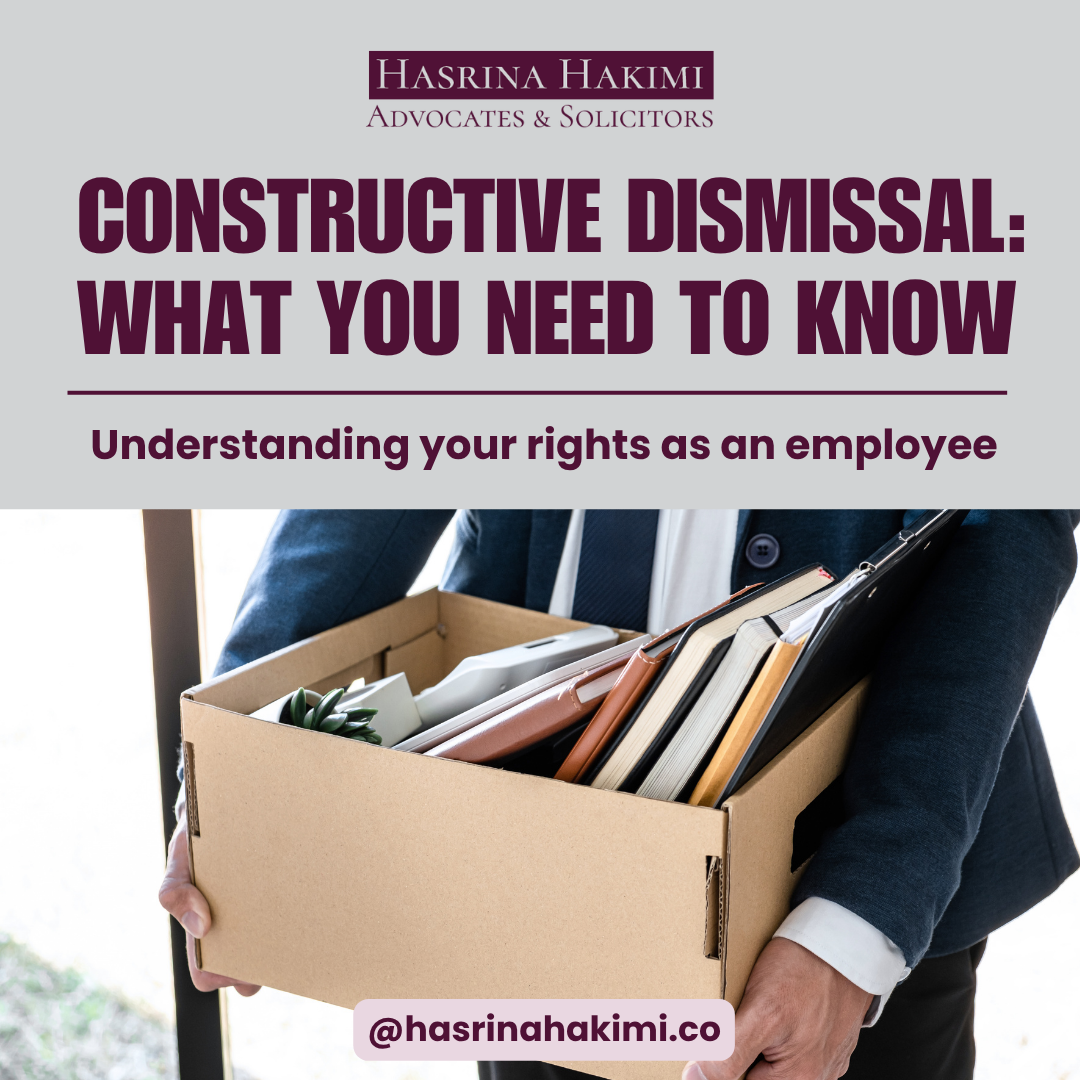
CONSTRUCTIVE DISMISSAL: WHAT YOU NEED TO KNOW – UNDERSTANDING YOUR RIGHTS AS AN EMPLOYEE
Introduction
In employment law, constructive dismissal occurs when an employee is compelled to resign not out of genuine free choice, but because the employer’s conduct has rendered the employment relationship untenable. Common examples include unilateral transfers to a role outside the agreed job scope, wrongful demotion, severe salary cuts, or managerial conduct that breaches the implied duty of mutual trust and confidence.
As expounded in established appellate jurisprudence:
“A constructive dismissal occurs when the employer commits either a present breach or an anticipatory breach of a fundamental term of a contract of employment thereby giving the employee a right, but not an obligation, to treat the employment contract as being at an end.”
Under Malaysian employment law, an employee who has been constructively dismissed is entitled to resign and lodge a representation for reinstatement or compensation under Section 20 of the Industrial Relations Act 1967 before the Industrial Court.
The Landmark ‘Contract Test’
In the seminal English authority of Western Excavating (ECC) Ltd v. Sharp [1978] IRLR 27, Lord Denning established the ‘Contract Test’ as the governing legal threshold to prove constructive dismissal. This test was formally adopted by the Malaysian Supreme Court in the landmark case of Wong Chee Hong v. Cathay Organisation (M) Sdn Bhd [1988] 1 MLJ 92, and reaffirmed by the Court of Appeal in CIMB Bank Bhd v. Ahmad Suhairi bin Mat Ali & Anor [2023] 5 MLJ 829.
To succeed, the employee must satisfy four cumulative conditions:
- Actual Breach of Contract: The employer must have committed a breach of the employment contract;
- Fundamental Gravity: The breach must be sufficiently serious (going to the root of the contract) to justify the employee walking out;
- Causal Link: The employee must have resigned in direct response to the employer’s breach, and not for external or unconnected personal reasons; and
- No Undue Delay: The employee must not delay excessively in resigning; otherwise, they are legally deemed to have waived the breach and affirmed the varied terms.
Critical Points to Be Considered by the Claimant
1. Burden of Proof
The legal burden of proof lies squarely on the employee. The claimant must prove to the Industrial Court, on a balance of probabilities, that all four conditions of the Contract Test have been satisfied.
2. Strict Timeframe and the Hazard of Delay
Timing is paramount. Upon discovering the employer’s breach, the employee must act promptly—either by lodging a written protest, serving notice, or tendering resignation. As held in Pexxon Sendirian Berhad v. Sia Qui Yau, Johore [1989] 2 ILR 235, an unexcused delay of even one month may be construed as unreasonable, leading the court to conclude that the employee affirmed the altered contractual terms.
3. Express Duty to Protest
The employee must clearly communicate the grounds of grievance in writing. The resignation letter must explicitly protest the breach and state that the employee considers themselves constructively dismissed due to the employer’s unlawful conduct.
4. Avoiding Premature Resignation
Resigning in anticipation or fear of a potential future breach, rather than an actual manifested breach, is fatal to a claim. Similarly, abruptly abandoning employment without serving formal protest or following proper procedural protocols significantly diminishes the prospects of success.
5. Management Prerogative vs. Bad Faith
While employers retain the managerial prerogative to transfer and re-designate staff, this right is not absolute. A transfer must be exercised bona fide (in good faith), must not inflict financial detriment or humiliating demotion, and must be grounded on sound operational reasons. Transfers calculated to victimize or coerce an employee out of the organization constitute constructive dismissal.
Conclusion
Constructive dismissal claims are highly fact-specific and require meticulous documentary evidence from the outset. If you are experiencing unlawful contractual changes, unfair demotion, or intolerable working conditions, it is critical to seek specialized legal advice before tendering your resignation letter.
Disclaimer: This article is for informational purposes only and does not constitute formal legal advice. For tailored guidance regarding employment disputes and Industrial Court claims, please contact Hasrina Hakimi Advocates & Solicitors directly.