
2023
ESTATE PLANNING FOR SPECIAL NEEDS CHILDREN
admin@hasrina
September 3, 2026
ESTATE PLANNING FOR SPECIAL NEEDS CHILDREN
For parents of children with special needs, long-term estate planning is one of the most vital responsibilities to undertake. Ensuring ongoing financial stability, specialized medical care, personal support, and capable guardianship requires a well-structured legal framework that remains effective throughout the child’s lifetime.
A. Will (Wasiat)
A Will is a formal legal declaration that carries out the desires, instructions, and asset distributions of the testator (parent) after their demise. In the context of a special needs child, a Will serves the following purposes:
- Distribution of Estate Matters: Clearly distributes all categories of assets, including specific bequests, general gifts, and the residuary estate.
- Appointment of Guardian / Caretaker: Designates a trusted legal guardian to care for the special needs child, together with provisions for caregiving allowances.
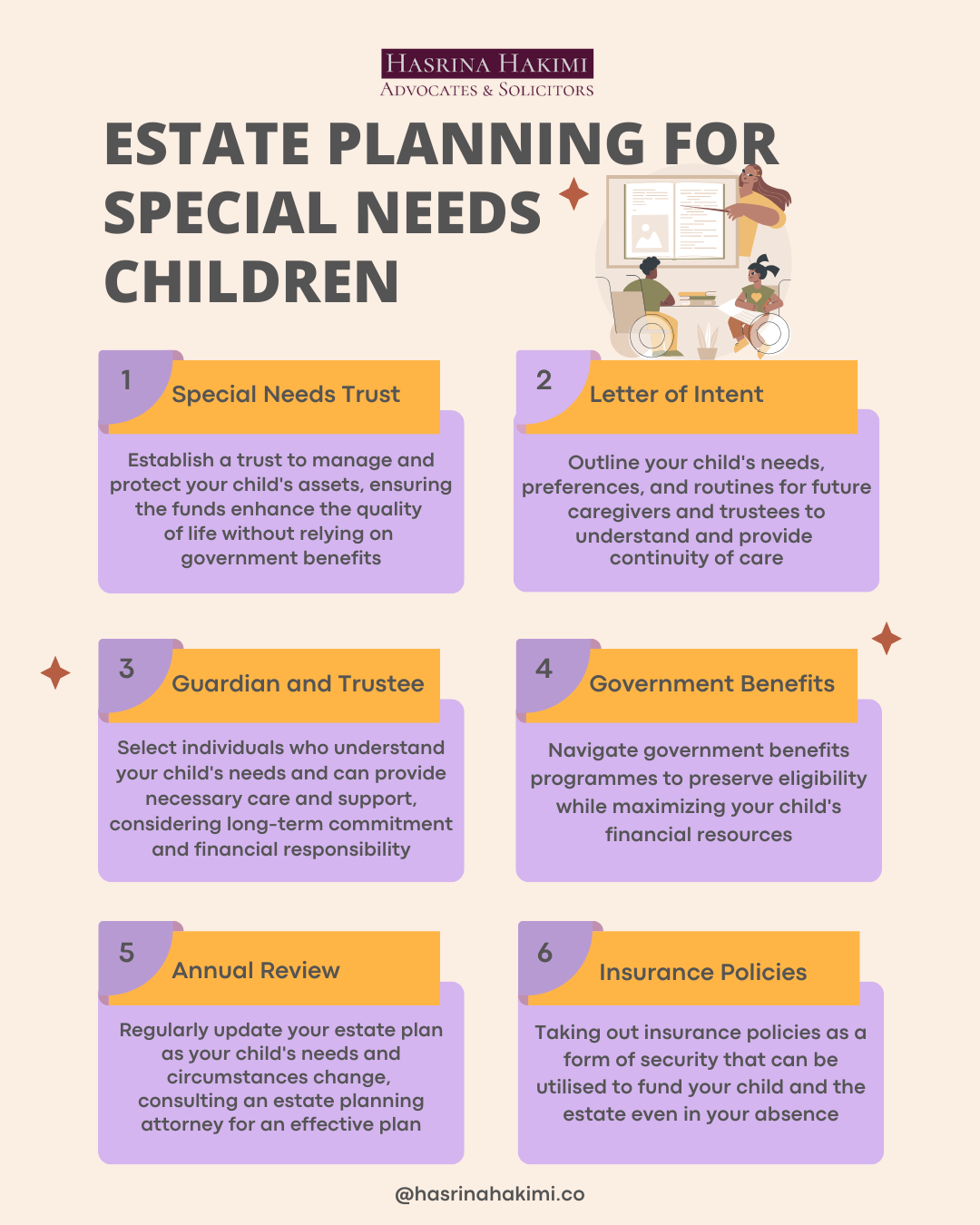
- Letter of Intent (Memorandum of Wishes): The Will can be supplemented by a detailed Letter of Intent outlining the child’s daily routines, food preferences, medical conditions, therapy schedules, and personal habits. This serves as an indispensable roadmap for future caregivers and can be kept in a sealed envelope alongside the Will.
Key Limitations of a Will:
- Probate Delay: Extracting a Grant of Probate from the High Court typically takes several months. During this interim period, estate bank accounts remain frozen, leaving the immediate daily and medical needs of the child vulnerable.
- Triggered Only Upon Death: A Will has no legal effect while the parent is still alive. If the parent suffers severe mental incapacity, stroke, dementia, coma, or goes missing, the Will cannot operate to release funds for the child.
B. Special Needs Trust
A Trust is a legal arrangement where assets are transferred to an independent trustee to hold, invest, and administer for the sole benefit of the special needs child.
The Essential Parties to a Trust:
- Settlor: The parent who transfers the assets into the trust.
- Trustee: The entity holding legal title to manage the funds in strict compliance with the Trust Deed.
- Beneficiary: The special needs child who holds the equitable and beneficial interest in the funds.
Why a Special Needs Trust is Superior:
- Specific & Customized Disbursements: The trust deed can detail precise periodic allocations for:
- a) Education and special schooling fees
- b) Daily living, dietary, and accommodation expenses
- c) Ongoing medical treatments, therapies, and medications
- d) Prudent investment of trust capital
- e) Recreation, vacations, and personal entertainment
- Flexible Commencement: Unlike a Will, a Trust can be activated immediately upon death, permanent disability, mental incapacity, or when the settlor is reported missing. There is no need to wait for court probate.
- Duration of the Trust: The trust can be structured to last for the child’s entire lifetime.
- End-of-Trust Succession: The deed can specify what happens to any remaining funds after the child’s demise (e.g., distributed to surviving siblings or donated to charitable organizations).
Appointing a Licensed Corporate Trustee (ATCM Member):
It is strongly advised to appoint a professional Trust Company registered under the Association of Trust Companies Malaysia (ATCM) rather than an individual trustee. An individual trustee may fall ill, pass away before the child, mismanage funds, or face conflicts of interest. In contrast, licensed Trust Companies operate under strict statutory regulation, do not die or fall sick, and provide institutional longevity, impartiality, and professional fund administration.
Common Types of Trust Structures for Special Needs Children:
- 1. Insurance-Funded Trust:
The trust is funded using life or disability insurance proceeds. The settlor assigns the policy rights to the Trust Company or names the Trust Company as trustee-nominee. Upon the parent’s death or permanent disability, the insurer pays policy proceeds directly into the trust without going through probate. - 2. Asset / Cash Account Trust:
The trust is funded using savings, investment portfolios, or real properties of the settlor. By executing a Power of Attorney (PA) in favour of the Trust Company, the trustee can immediately take over account operations upon incapacity or demise to maintain uninterrupted care for the child.
C. Life & Disability Insurance Policies
Parents are encouraged to secure life and total permanent disability (TPD) insurance policies as a cornerstone of their estate plan.
Rationale: Maintaining lifelong special care, nursing, specialized therapy, and corporate trustee management entails substantial expenses. Insurance creates immediate liquidity upon the parent’s demise, ensuring ample capital is available to fund the trust without forcing the sale of the family residence or business assets.
D. Registration as a Person with Disabilities (OKU Card)
Registering the child with the Department of Social Welfare Malaysia (Jabatan Kebajikan Masyarakat / JKM) under the Persons with Disabilities Act 2008 (PWD Act) is an indispensable future safeguard.
Benefits & Protections Accessible via OKU Registration:
- Financial assistance allowances and grants from JKM
- Access to government special education and vocational training programs
- Subsidized healthcare and medical equipment at government hospitals
- Tax relief for parents (and higher tax relief for special needs individuals)
- Public transportation and utility concessions
- Government housing access and institutional welfare safeguards if family funds are ever exhausted
Under the Persons with Disabilities Act 2008, persons with disabilities encompass individuals with long-term physical, mental, intellectual, or sensory impairments. JKM recognizes 7 official disability categories:
- Hearing Disability / Impairment
- Visual Disability / Impairment
- Speech Disability / Impairment
- Physical Disability / Impairment
- Learning Disability: Individuals with developmental conditions such as Down Syndrome, Autism Spectrum Disorder (ASD), ADHD, global developmental delay, and intellectual challenges.
- Mental Disability / Impairment: Individuals with severe, clinically diagnosed psychiatric conditions (e.g., severe chronic disorders treated for at least 2 years).
- Multiple Disabilities / Impairments: Individuals who suffer from more than one form of disability.
Conclusion: Combining a Special Needs Trust, an updated Will with a Letter of Intent, adequate Insurance Funding, and official OKU Registration ensures that your child is completely sheltered financially, legally, and practically—no matter what the future holds.