
2025
DIVIDING THE MATRIMONIAL PIE: YOUR GUIDE TO ASSET DIVISION IN MALAYSIAN DIVORCE
admin@hasrina
September 3, 2026
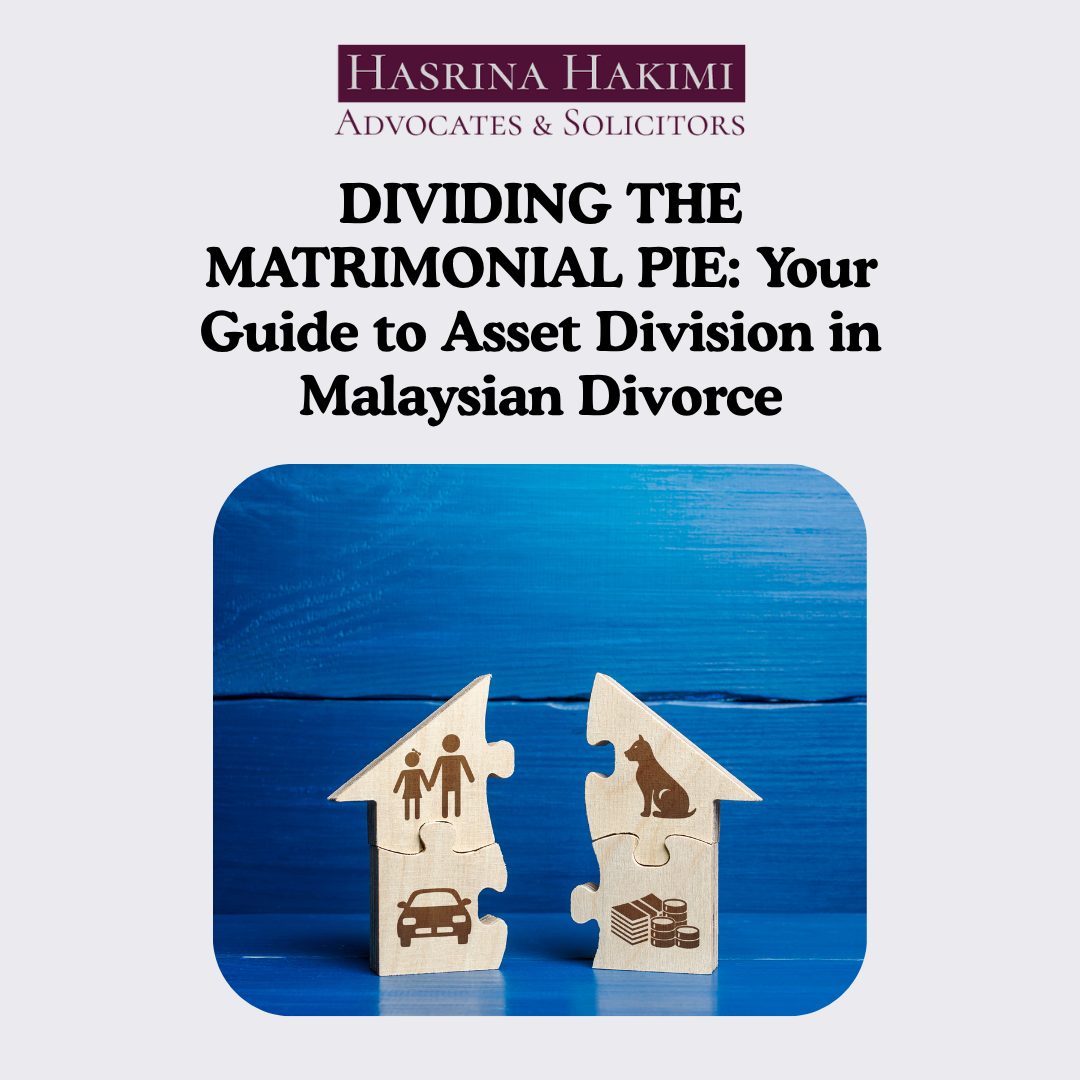
DIVIDING THE MATRIMONIAL PIE: YOUR GUIDE TO ASSET DIVISION IN MALAYSIAN DIVORCE
When a marriage comes to an end, one of the most painful and complex questions that follows is:
“How will our assets be divided?”
Homes, vehicles, savings, and investments that were once accumulated together in partnership suddenly become subjects of contentious dispute. Understandably, asset division can be one of the most emotionally charged aspects of a divorce proceeding.
In Malaysia, the division of matrimonial property for non-Muslim marriages is governed under Section 76 of the Law Reform (Marriage and Divorce) Act 1976 (LRA 1976). The law provides structured principles to ensure that both the financial and non-financial contributions of both spouses are recognized fairly and equitably.
What Counts as “Matrimonial Property”?
In Malaysia, not every asset owned by either spouse is automatically subject to division upon divorce (Yap Yen Piow v. Hee Wee Eng [2017] 1 MLRA 389). In determining what falls into the matrimonial pool, the courts consider:
- Timing of Acquisition: Whether the asset was acquired during the subsistence of the marriage, either jointly or through the sole effort of one party.
- Scope of Assets: Matrimonial property includes real estate, motor vehicles, bank savings, business shares, and Employees Provident Fund (EPF) contributions. Crucially, under Chee Kok Choon v. Sern Kuang Eng [2005] 4 MLJ 461, only the portion of EPF savings accumulated during the marriage is subject to division.
- Pre-Marital Assets, Gifts, and Inheritances: Assets acquired prior to marriage, inherited properties, or personal gifts are generally excluded from the matrimonial pool under Section 76(5) of the LRA, unless the other spouse can establish that they contributed toward improving or enhancing the asset (e.g. paying for renovations or ongoing maintenance).
How Courts Divide Assets: The Principle of Fairness
Under Section 76 of the LRA, the court exercises broad equitable discretion to divide property based on what is just and equitable, which does not necessarily mean an automatic 50:50 arithmetic split. The statute categorizes property into two distinct classes:
(a) Property Acquired by Joint Effort (Section 76(1))
Where both spouses contributed toward acquiring or improving the asset, the court considers:
- Direct financial contributions made toward the purchase price or mortgage installments;
- Non-financial contributions made toward the welfare of the family (caring for the home and children);
- Debts and liabilities incurred by either party for the joint benefit of the family; and
- The material needs of any minor children of the marriage.
(b) Property Acquired by Sole Effort (Section 76(3))
Where an asset was purchased and funded solely by one spouse, the non-acquiring spouse is nonetheless legally entitled to a share if they indirectly contributed to the marriage—for instance, by managing the household, running family affairs, and freeing the breadwinner to focus on career and wealth generation.
Recognising Non-Financial Contributions: Homemaking Counts!
A hallmark of modern Malaysian matrimonial law is the legislative and judicial recognition of non-financial contributions under Section 76(2)(aa).
The superior courts have consistently emphasized that marriage is an equal partnership of life, not merely an economic transaction. Even if one spouse had zero independent income throughout the marriage, their devotion in maintaining the household, raising children, and providing emotional support is treated as valuable, compensable contribution to the matrimonial wealth.
Typical Judicial Ratios in Practice
While each divorce is judged on its unique facts, Malaysian courts generally apply the following benchmarks:
- Jointly Acquired Property: Courts frequently order a 50:50 or 60:40 split, reflecting the combined direct and indirect efforts of both spouses;
- Sole-Effort Property: The non-acquiring homemaker is typically awarded between 10% to 30% of the asset’s net value, acknowledging their domestic support (Loke Sow Leng v. Yap Eng Kee [2004] MLJU 290; Shireen a/p Chelliah Thiruchelvam v. Kanagasingam a/l Kandiah [2012] 7 MLJ 315); and
- Custodial Parent Considerations: Where minor children require stable housing, the parent awarded custody may be granted a larger proportion or the right to reside in the matrimonial home until the children reach the age of majority.
How to Prove Your Contributions in Court
Parties can establish their claims by providing cogent documentary and testimonial evidence:
- Bank account records, payment vouchers, mortgage loan schedules, and renovation receipts;
- Testimonies and records demonstrating full-time childcare, school runs, and home maintenance; and
- Joint account statements or evidence of shared household expenditures.
Even where receipts are unavailable, courts give substantial weight to the duration of the marriage, credible witness statements, and the overall domestic matrix (Owen Koh Tat Gin v. Diana Lee Cheng See [2021] 11 MLJ 20).
Conclusion & Legal Guidance
Navigating the division of matrimonial assets can be daunting, but understanding the legal framework provides certainty, empowerment, and protection. Malaysian law recognizes that whether a spouse provided financial resources or domestic stability, both contributions are deeply valued. The ultimate objective is ensuring that each party walks away with a fair and equitable share of what was built together.
Disclaimer: This article is for informational purposes only and does not constitute formal legal advice. Every family circumstance is unique. If you require legal consultation regarding divorce, asset division, or matrimonial rights, please contact Hasrina Hakimi Advocates & Solicitors directly.