

2025
ICJ ADVISORY OPINION ON ISRAEL’S OBLIGATIONS: REAFFIRMING INTERNATIONAL LEGAL DUTIES IN THE OCCUPIED PALESTINIAN TERRITORY
admin@hasrina
September 3, 2026
ICJ ADVISORY OPINION ON ISRAEL’S OBLIGATIONS: REAFFIRMING INTERNATIONAL LEGAL DUTIES IN THE OCCUPIED PALESTINIAN TERRITORY
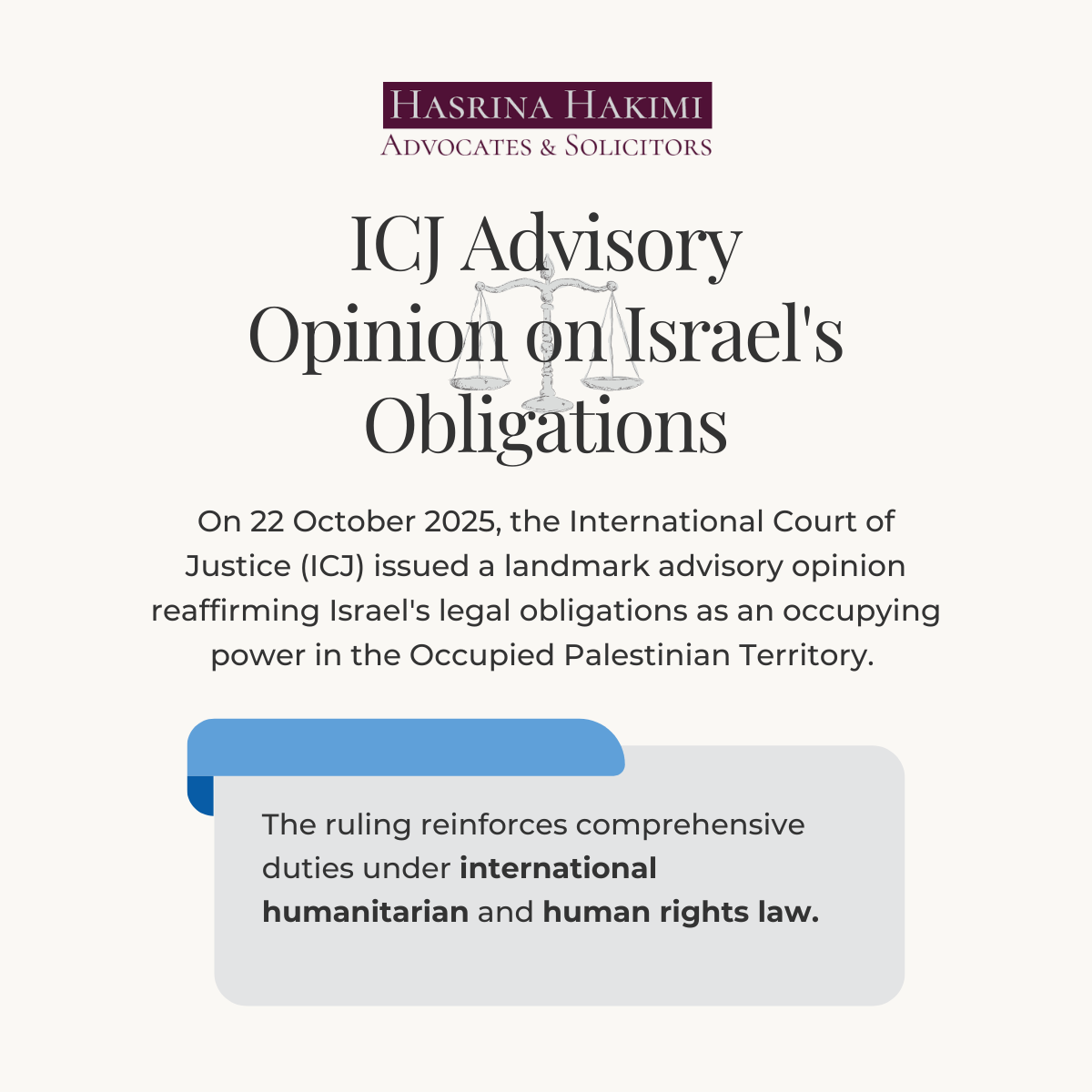
In an authoritative Advisory Opinion delivered by the International Court of Justice (ICJ), the principal judicial organ of the United Nations reaffirmed Israel’s non-derogable obligations as an occupying power under International Humanitarian Law (IHL) and International Human Rights Law (IHRL) in relation to the Occupied Palestinian Territory (OPT).
These binding legal duties arise principally from the Fourth Geneva Convention (1949), the Hague Regulations (1907), and Additional Protocol I (1977), alongside customary international law and multilateral human rights treaties—including the ICCPR, ICESCR, CEDAW, the Convention Against Torture (CAT), the Convention on the Rights of the Child (CRC), and the Convention on the Rights of Persons with Disabilities (CRPD). Together, these instruments establish an uncompromising international framework obliging the occupying power to ensure the protection, welfare, and basic human dignity of the civilian population under its military control.
Eight Core Legal Obligations of Israel as an Occupying Power
- Unconditional Facilitation of Humanitarian Relief (Article 59 Fourth Geneva Convention):
Under Article 59, Israel is legally bound to permit and facilitate the unimpeded passage of all humanitarian relief schemes whenever the local civilian population is inadequately supplied. This obligation is absolute and unconditional, applying equally to relief provided by sovereign States, the United Nations, and impartial humanitarian organizations such as UNRWA. - Support for UNRWA & International Humanitarian Agencies:
Israel must actively cooperate with and facilitate the operations of the United Nations Relief and Works Agency for Palestine Refugees (UNRWA) and other international relief bodies, formally recognizing their neutral, impartial humanitarian mandate and irreplaceable operational infrastructure in Gaza. - Ensuring Basic Subsistence Needs of the Population:
Pursuant to Articles 55 and 56 of the Fourth Geneva Convention and Article 69(1) of Additional Protocol I, Israel is duty-bound to ensure the civilian population has adequate access to food, potable water, medical supplies, and hospital facilities, and must refrain from obstructing relief distribution. - Inviolable Protection of Relief and Medical Personnel:
Humanitarian workers, doctors, nurses, and medical personnel must be respected, shielded, and protected from attack at all times under customary international law. Restrictions on their movements are strictly limited to imperative, extraordinary military necessity. - Strict Prohibition of Forcible Transfer or Deportation (Article 49):
Article 49 of the Fourth Geneva Convention strictly prohibits individual or mass forcible transfers, expulsions, or deportations of protected civilians from occupied territory, as well as the deliberate creation of unlivable conditions designed to compel civilian displacement. - Prohibition of Starvation as a Method of Warfare:
Both customary international humanitarian law and Article 54 of Additional Protocol I unconditionally outlaw the use of starvation of civilians as a method of warfare, including the destruction or denial of objects indispensable to civilian survival (agricultural areas, drinking water installations, and food distribution depots). - Full Extraterritorial Application of Human Rights Treaties:
Israel remains statutorily and legally bound to respect, protect, and fulfill the fundamental human rights of Palestinians under the international human rights conventions to which it is a State Party throughout the occupied territories. - General Duty of Civil Administration:
Under the Hague Regulations, an occupying power does not acquire sovereignty; it holds mere temporary de facto administration. It is required to administer the territory for the genuine welfare of the indigenous population, preserving public order, essential civil infrastructure, and the rule of law.
Key ICJ Evidentiary Findings & Observations
In examining the factual reality on the ground, the ICJ reached several critical determinations:
1. Severe Civilian Deprivation Triggering Article 59:
The Court concluded that the civilian population in Gaza has been severely and chronically deprived of essential survival goods, creating an immediate, mandatory trigger for Israel’s duties under Article 59. The Court highlighted that Israel systematically blocked or critically restricted aid access, resulting in catastrophic humanitarian deprivation.
The Court concluded that the civilian population in Gaza has been severely and chronically deprived of essential survival goods, creating an immediate, mandatory trigger for Israel’s duties under Article 59. The Court highlighted that Israel systematically blocked or critically restricted aid access, resulting in catastrophic humanitarian deprivation.
2. Dismissal of Allegations Against UNRWA:
The ICJ firmly rejected assertions questioning UNRWA’s institutional neutrality, finding zero credible evidence presented to justify the delegitimization or disruption of UNRWA’s lifesaving operations.
The ICJ firmly rejected assertions questioning UNRWA’s institutional neutrality, finding zero credible evidence presented to justify the delegitimization or disruption of UNRWA’s lifesaving operations.
3. Violations Amounting to International Crimes:
The Court underscored that the arbitrary denial of humanitarian aid, systematic obstruction of convoys, siege tactics, and coerced displacement may constitute grave breaches of the Fourth Geneva Convention and Additional Protocol I, engaging international state and individual criminal responsibility.
The Court underscored that the arbitrary denial of humanitarian aid, systematic obstruction of convoys, siege tactics, and coerced displacement may constitute grave breaches of the Fourth Geneva Convention and Additional Protocol I, engaging international state and individual criminal responsibility.
Conclusion
The International Court of Justice has delivered a definitive legal verdict: military occupation carries profound legal accountability, not sovereign entitlement or impunity. The protection of non-combatant civilians, unhindered delivery of life-saving medical aid, and the preservation of human dignity are peremptory norms of international law that cannot be set aside by political expedience or military objectives.
Disclaimer: This article is for informational and educational purposes only and does not constitute formal legal counsel. For inquiries regarding public international law, human rights compliance, or cross-border treaties, please contact Hasrina Hakimi Advocates & Solicitors directly.