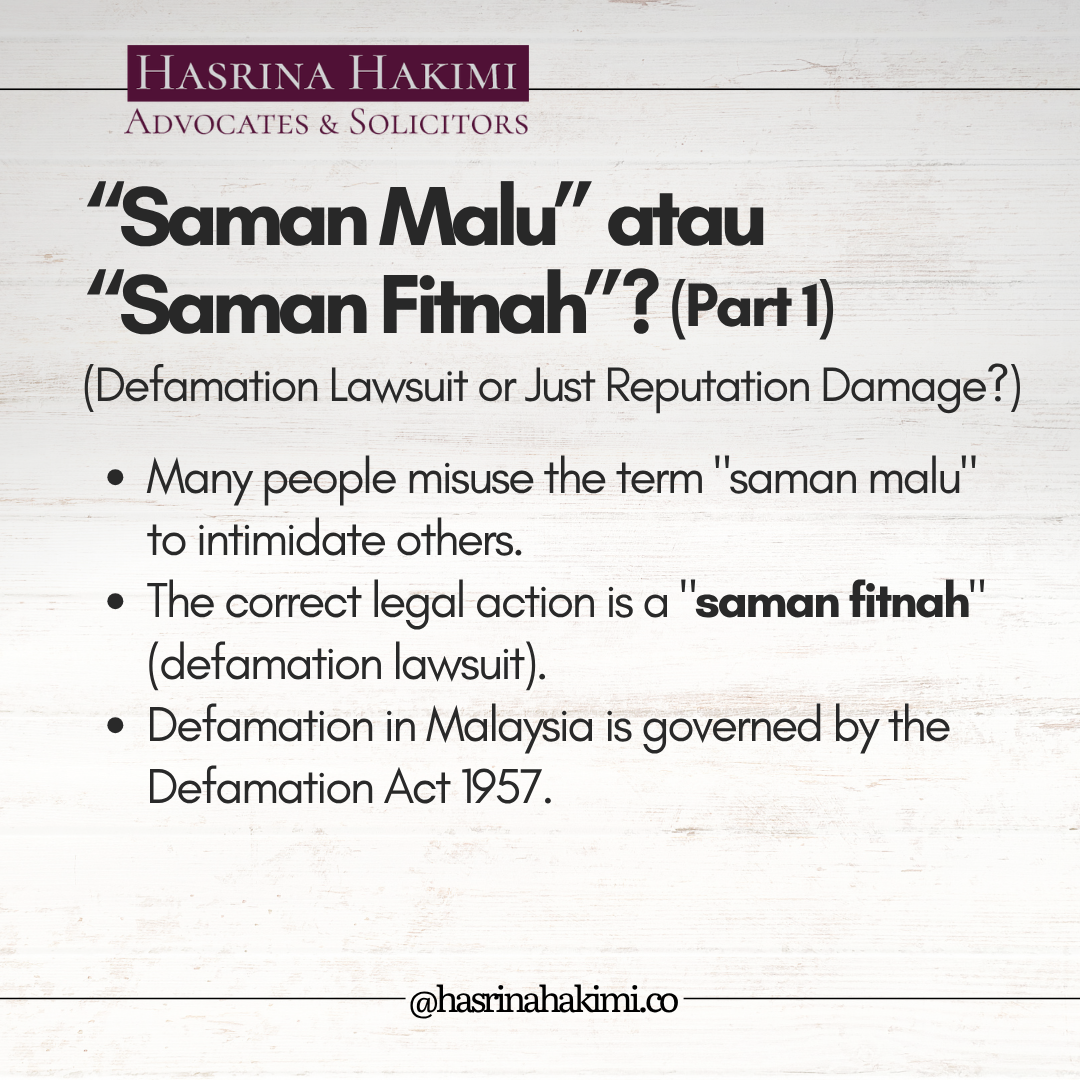
“SAMAN MALU” ATAU “SAMAN FITNAH”? (PART 1)
How often do we hear people throw around the phrase “Aku saman malu kau!” in an attempt to intimidate others? But does the concept of “saman malu” actually exist under Malaysian law?
While it has become part of colloquial everyday slang, there is legally no such thing as “saman malu”. Simply feeling embarrassed, offended, or insulted does not give rise to a valid legal claim.
The true, actionable cause of action recognized by Malaysian superior courts is saman “fitnah”, or in English, a Defamation lawsuit. In Malaysia, civil defamation is governed by the common law and codified under the Defamation Act 1957.
The Three Fundamental Elements of a Defamation Suit
Before you can commence legal proceedings against someone for defaming your character, you must satisfy three mandatory legal requirements:
- The statements complained of must be defamatory in nature;
- The statements must refer directly or indirectly to the Plaintiff; and
- The statements must have been published to at least one third party.
1. When is a Statement “Defamatory”?
The Malaysian court applies an objective standard rather than looking at the sensitive feelings of the plaintiff:
“…to consider the meaning such words would convey to ordinary reasonable persons using their general knowledge and common sense; it is not confined to strict literal meaning of the words but extends to any references or implication from which persons can reasonably draw.”
— Tun Datuk Patinggi Haji Abdul Rahman Ya’kub v. Bre Sdn Bhd & Ors [1995] 4 MLRH 877
In essence, defamatory statements are words that tend to lower the plaintiff in the estimation of right-thinking members of society, expose them to public hatred, contempt, or ridicule, or cause them to be shunned or avoided.
Common Defamatory Examples in Malaysia:
- “This person is a scammer!”
- “Lelaki ini telah cuba untuk menipu duit syarikat.”
- “Perempuan ini telah cuba merampas suami orang.”
2. Reference to the Plaintiff
The Plaintiff does not need to be explicitly named. It is sufficient if reasonable persons acquainted with the plaintiff would understand that the statement refers to them through context, descriptions, or innuendo.
3. Publication
A private insult uttered solely between two individuals in a private room is not actionable defamation. The words must be communicated or published to at least one third party (whether via social media, WhatsApp groups, emails, or public speech).
Libel vs. Slander: What If the Defamation Was Spoken Orally?
Defamation is classified into two distinct forms:
- Libel: Defamation in permanent form (written text, social media postings, articles, emails, or recorded videos). Libel is actionable per se—meaning damages are presumed and you do not need to prove actual financial loss.
- Slander: Defamation in temporary, non-permanent form (spoken words, gestures, or oral remarks).
Illustration: In a crowded shopping mall, someone loudly accosts you and brands you a “thief and cheat” in front of hundreds of onlookers, and the video subsequently circulates online. As a result, your commercial contracts are cancelled.
General Rule for Slander: Generally, slander requires proof of special damage (actual pecuniary, financial loss).
However, the Defamation Act 1957 creates crucial statutory exceptions where slander is actionable per se (without proving special damages):
- Slander of Women (Section 4): Imputing unchastity or adultery to any woman or girl;
- Slander Affecting Official, Professional, or Business Reputation (Section 5): Words calculated to disparage a person in their trade, office, profession, or business;
- Imputation of a Contagious or Infectious Disease; and
- Imputation of a Criminal Offense: Alleging the commission of an offense punishable by imprisonment.
Conclusion & What Comes Next
The next time someone threatens you with “saman malu”, remember: the law protects personal and commercial reputation against false, published statements (saman fitnah), not bruised egos. If you are on the receiving end of defamatory claims or need to protect your professional standing, understanding these three baseline elements is essential.
Stay tuned for Part 2 of our series: “Defences to Defamation: What You Need to Know”, exploring Justification, Fair Comment, and Privilege.
Disclaimer: This article is for informational purposes only and does not constitute formal legal advice. If your reputation has been injured or you have received a letter of demand, contact Hasrina Hakimi Advocates & Solicitors for an immediate legal consultation.