
Hasrina Hakimi Advocates & Solicitors



Guide to apply for Scheme of Arrangement and Restraining Order under the
Companies Act 2016 in Malaysia (Part 2 )
When can the Scheme Creditors apply to Court to protect their rights? And how?
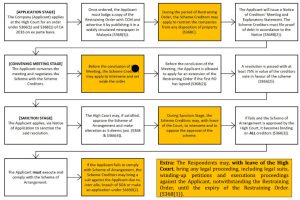
Relevant Statutory Provisions and Court Cases in Malaysia in respect of the Scheme of Arrangement under Companies Act 2016
Application to Restrain from any Disposition of Properties
Under Section 368C of the Companies (Amendment) Act 2024, creditors may apply to
restrain the Companies from disposing of their properties, including shares, except in the
ordinary course of business. This restraining order should be granted for a period that
extends until the expiry of the restraining order under Section 368(1) of the Companies Act
2016, i.e., to prevent any action or proceeding from being commenced while the scheme of
arrangement is being proposed to the creditors and concluded by the parties.
Such application is in line with Section 368(4) and (7) of the Companies Act 2016, where
they state that during the period of the Restraining Order, any disposition of the Company’s
properties is void, and any attempt to dispose the property can only be done subject to
leave of the High Court.
Setting Aside the Order to Convene the Creditors’ Meeting and Restraining Order (“Ex
Parte Order”)
Before the conclusion of the Creditors’ Meeting, a creditor may seek for leave at the High
Court to intervene the Company’s application under S366 and 368(1) of the Companies
Ac 2016, in accordance with Order 15 rule 6(2) of the Rules of Court 2012. Thereafter, a
creditor must prove to the Court that he has some interest which is directly related to the
subject matter of the action, i.e., the Scheme of Arrangement and that his interest (rights or
liability) will be directly affected by any order of the court1. Concurrently, a creditor may
seek leave from the Court to set aside the Ex Parte Order2. In Malaysia, there are few
grounds which a creditor may rely on setting aside the Ex Parte Order and they are:-
(a) The Scheme of Arrangement lacks of full and frank disclosure.
i. MDSA Resources Sdn Bhd v. Adrian Sia Koon Leng [2023] 7 CLJ 843; [2023]
5 MLJ 900 (FC) Nordin Hassan FCJ – The Federal Court in affirming the decision
of the Court of Appeal which dismissed the application for sanction order, held
as follows:-
“[54] No doubt that the court has the power to order further meetings of creditors
and to furnish the relevant particulars needed by the creditors by having an
amended explanatory statement. That is not the point here, the scheme company,
the appellant, should not withhold any material information that affected
the decision in the voting even at the meeting stage. This is prejudicial to the
creditors in deciding to vote for or against the proposed scheme, in
particular those who did not attend the meeting after reading the
explanatory statement which lacked of the material particulars. In The Royal
Bank of Scotland case (supra) this was said:
… Disclosure of material information about the scheme or the company’s affair
ought not to be deliberately withheld until the meeting so as to influence its
outcome. This would unfairly prejudice those who may have decided not to attend
after considering the information sent to them earlier and will likely be seen as an
attempt to improperly influence the voting outcome.”
ii. Further, it is settled law that any party applying for an Ex Parte Application must
disclose all material facts by way of Affidavit3. This also applies in cases relating
to scheme of arrangement. PECD Bhd & Anor v AmTrustee Bhd and other
appeals [2010] 5 MLJ 357 (COA) Zaleha Zahari JCA (As she then was) – The
High Court allowed the application to set aside the ex parte order on the
grounds of non-disclosure of material facts. Specifically, the appellants had failed
to disclose what transpired in the first originating summons (OS) and the
decision of the Court of Appeal regarding the appeal from that OS when applying
for the setting aside of the ex parte order in the second OS.
iii. Hong Xin Construction Sdn Bhd V. Seng Hiap Glass Sdn Bhd & Ors [2024]
CLJU 73 (HC) – Shamsulbahri Ibrahim J held that the failure to disclose that the
nomination of Lee Kok Chew as a director for the scheme was not consented to
by a majority vote demonstrated a lack of bona fides and insufficient disclosure
by the company. Consequently, the ex parte order was set aside.
(b) Failure to satisfy any of the conditions under Section 368(2).
i. Mansion Properties Sdn Bhd v Sham Chin Yen & Ors [2021] 1 MLJ 527 (FC)
Mohd Zawawi Salleh FCJ (As he then was) –
[50] This view is further fortified when the matter is considered in the light of
other sub-sections in s. 368 of the CA. Section 368(2) to (7) of the CA imposes a
number of specific statutory safeguards in respect of restraining orders under s.
368(1). Among others, these include:
(i) the pre-conditions for the court to grant a restraining order to a company
under s. 368(1) of the CA. The court must be satisfied that there is a proposal for
a scheme of arrangement, that the restraining order is necessary to enable the
company and its creditors to formalise the scheme for approval, that a
statement of particulars as to the affairs of the company is lodged together with
the application, and that the court approves or appoints a person nominated by
the majority of creditors to act as director (s. 368(2) );
(ii) the person approved or appointed by the court has the right of access to all
of the company’s records, and is entitled to require any information from the
company as required (s. 368(3) );
(iii) unless the court otherwise orders, any disposition or acquisition of
company property, other than in the ordinary course of business, made after the
grant of the restraining order is void. Such an act constitutes an offence (ss.
386(4) – (7)); and
(iv) where a restraining order is granted, the company shall lodge a copy
thereof with the Registrar and publish a notice of the order in a widely
circulated newspaper (s. 386(5)).
[51] These statutory requirements are mandatory and any non-compliance
may render the restraining order liable to be set aside for irregularity (see:
Pelangi Airways Sdn Bhd v. Mayban Trustees Bhd (supra )).”
ii. Damai City Sdn Bhd V. Grand Dynamic Builders Sdn Bhd & Ors [ 2024] 5 CLJ
467 (HC) Mohd Arief Emran Arifin J – The application to intervene were not
objected by the applicant, thus, it was allowed by the High Court. The High Court
set aside the application for restraining order on the ground that it fails to
satisfy Section 368(2).
(c) Wrong classification of creditors
i. Airasia X Bhd v. BOC Aviation Ltd & Ors [2021] CLJU 188 (HC) Ong Chee
Kwan JC –
“[47] The task of classifying the creditors must be taken seriously and the
applicant assumes the risks of the application being dismissed at the
Convening Stage if the classification is found wanting as the Court has no
jurisdiction to sanction the proposed scheme if the creditors’ meeting(s) are
not properly constituted. The jurisdiction of the Court is conditional upon the
correct identification and composition of classes, for it is only when approved by
the appropriate classes, properly identified, selected and convened that the
majority could bind the company (See: UDL Argos Engineering & Henry Industries
Co Ltd v. Li Oi Lin [2001] 3 HKLRD 634 at [27(5)] (‘UDL Argos ‘), The Royal Bank of
Scotland NV (formerly known as ABN Amro Bank NV) and other v. TT
International Ltd and another appeal [2012] SGCA 9 (‘Royal Bank of Scotland ‘);
Re Apcoa Parking Holdings GmbH [2015] 2 BCLC 659 at 674, para [45] (‘Re
Apcoa’)).
[48] Although the issue of creditors’ classification was once thought better
left to be determined at the Sanction Stage (See: Lord Millet’s view in the Hong
Kong Court of Final Appeal case of UDL Argos), the more recent and prevailing
views are that this should now be taken at the Convening Stage.
[49] I would emphasise again that the decisions that are taken by the Court as to
the composition of classes at the Convening Stage is not to be treated as final and
the Court is not bound by its decision made at the Convening Stage See: Re Apcoa
at p. 673, para [42] to [43] where Hildyard J said:
[42] The principal jurisdiction question at the Convening Hearing is normally
the identification of the appropriate classes for the purpose of convening
meetings to vote upon the scheme proposals; but other matters going to
jurisdiction of the court may also be raised, and it is obviously optimal that
any such matters be adjudicated, if possible, since if the court lacks jurisdiction
there is no point in any class meetings at all.
[43] It is, however, important to emphasise that the function of the court at the
Convening Hearing is a limited one; and its decision, even on the question as to
the composition of classes, is not final, even though the court can be expected
not to change its mind of its own, at the third stage on matters it decided at
the first stage (since to do so would tend to subvert the purpose of the revised
practice).
e. Test of Classification of Creditors
[50] The classic test for identifying classes is formulated by Bowen LJ in Sovereign
Life Assurance Co v. Dodd [1892] 2 QB 573 (‘Sovereign Life ‘) that a class ‘must be
confined to those persons whose rights are not so dissimilar as to make it
impossible for them to consult together with a view to their common interest’.”
6
ii. MDSA Resources Sdn Bhd v. Adrian Sia Koon Leng [2023] 7 CLJ 843 (FC)
Nordin Hassan FCJ – The Federal Court in affirming the decision of the Court of
Appeal which dismissed the application for sanction order, held as follows:-
“a wholly-owned subsidiary or related party of a company that proposed a scheme
of arrangement under the CA should not be placed in a single class of creditors due
to their special interest in promoting the scheme.”
iii. Re Prestariang Skin Sdn Bhd [2022] MLJU 1746 (HC) Liza Chan Sow Keng JC
– The intervening application was dismissed as Unique Central was not a
creditor as defined by PSKN in its Explanatory Statement. As such, Unique
Central cannot be said to be part of the scheme, and therefore it is not bound by
the scheme. As such, Unique Central was allowed to continue its suit it has
brought previously against PSKN prior to the Court’s sanction.
(d) Scheme of Arrangement is not viable or workable
i. Intrakota Komposit Sdn Bhd & Anor v. Sogelease Advance (M) Sdn Bhd
[2004] 8 CLJ 276; [2004] MLJU 588 (HC) Abdul Malik Ishak J (As he then
was):
“… The court will not permit a scheme which is not viable, feasible, workable or
intelligible from being put before the creditor because to do so would be a waste
of time since the creditor would certainly reject the proposal… (emphasis added)”
ii. Twenty First Century Oils Sdn Bhd V Bank Of Commerce (M) Bhd & Ors
(No 2) [1993] 2 MLJ 353 (HC) Abdul Malek J (As he then was) held:-
“A proper reading of the proposed scheme of arrangement showed that the
scheme was not viable, feasible, workable or intelligible. That aside, even if the
meeting was allowed to be held, with the same objections canvassed thereat, it
would certainly result in the proposed scheme being rejected. It was more proper
and logical, therefore, not to have the scheduled meeting at all as no purpose
would be served.”
Nevertheless, it is to be borne in mind the Court will look at the facts of the case, the
arguments of the parties and the evidence to support their arguments. As such, the success
rate in this application mostly depends on the case itself, and the Court has the
discretionary power whether to grant or dismiss the setting aside application.
7
For example, in Globalcon Holding (M) Sdn Bhd V. Ambank Islamic Berhad & Anor (HC)
– Ong Chee Kwan J in dismissing the setting aside application held that the arguments of the
quantum of the debts and or the omission of their unsecured debts are not adequate
grounds to justify setting aside. They can be cured by filing proof of debts.
Opposing the Scheme during the Sanction Stage
Once the scheme of arrangement has been concluded and has received the requisite
majority votes, the company may apply for a sanction order to approve the scheme
(“Sanction Order”). This order, once granted, will bind all creditors described in the notice
of meeting and/or the explanatory statement attached to it4.
In order to apply for a Sanction Order, the company must make an application using a
Notice of Application. This procedure is outlined by Wan Muhammad Amin JC (As he then
was) in BGMC Holdings Bhd (formerly known as BGMC Holdings Sdn Bhd) v. Fulloop
Sdn Bhd & Ors [2023] 9 MLJ 465. The court held that the proper method for applying for
a sanction order is by Notice of Application, rather than an originating summons. This is to
ensure that the matter is heard by the same judge who have dealt with the case during the
grant of the order to convene the creditors’ meeting and as well as a restraining order
pursuant to Section 366 and 368(2).
Based on the above, when applying for a sanction order, the Court must be satisfied of the
following requirements by the Company5:-
(a) the requirements and the provisions under Companies Act 2016 have been complied
with;
(b) that the class of creditors and/or members was fairly represented and that there is
not any coercing of the minority by the majority;
(c) that the scheme is fair and reasonable, according to an intelligent and honest person,
being a creditor or member of the class may reasonably approve ; and
(d) that there is no ‘blot’ or defect in the Scheme.
According to Ramly Ali J (As he then was) held in In Re Sateras Resoucers (Malaysia) Bhd
[2005] 6 CLJ 194 (HC) that “the Court shall not act as a mere rubber stamp to endorse the
Proposed Scheme” notwithstanding that the Scheme has obtained a majority vote and that it
is in compliance with the statutory requirements under CA2016. This means that the Court
4 Section 366(3) of the Companies Act 2016
5 Re Sateras Resoucres (Malaysia) Bhd [2005] 6 CLJ 194 (HC); Re Noble Group Ltd [2018] EWHC 3092 (Ch);
Airasia X Bhd v BOC Aviation Ltd & Ors [2021] 10 MLJ 942 (HC); Sham Chin Yen & Ors v Mansion Properties
Sdn Bhd [2019] MLJU 1830 (COA); Transmile Group Berhad & Anor v. Malaysian Trustee Berhad & Ors [2013]
2 MLRH 427 (HC); Sentoria Bina Sdn Bhd v Impak Kejora Sdn Bhd & Ors [2021] 12 MLJ 690 (HC)
8
must thoroughly examine the fairness and reasonableness of the Scheme and evaluates the
Scheme proposed. The Court Sanction is not merely a formality.6
Notwithstanding the above, Malaysian courts are normally slow or cautious in interfering
with the decision of the majority of the creditors in the creditors’ meeting except if the
scheme is done wrongly which causes a miscarriage of justice7.
Bringing a legal action or an application for failure to comply with the Scheme of
Arrangement
On 1st April 2024, the Companies Act 2016 was amended to finally address the issue of
breach of a Scheme of Arrangement. Previously, the lack of explicit statutory recognition
and the scarcity of court cases on this matter had left creditors without any clear options.
This was detrimental to creditors as they did not have a proper forum to bring their cases
and enforce their rights.
Section 369D(2) of the Companies (Amendment) Act 2024 states:-
“(2) Where the Court is satisfied that the company has committed an act or omission, or
make a decision, that results in a breach of any terms of the compromise or
arrangement, the Court may, on an application of any creditor bound by the compromise
or arrangement –
(a) confirm, reverse or modify the act, omission or decision of the company; or
(b) give such direction or make such order as the court thinks fit to rectify the act,
omission or decision of the company.
This means that the creditors can now make an application in court to seek redress if the
company commits an act or omission, or makes a decision, that results in a breach of any
terms of the compromise or arrangement. However, to date, there has yet to be any case law
where the court has dealt with this provision or issued an order under this provision.
Prior to this amendment, only Ong Chee Kwan J in Top Builders Capital Bhd & Ors v Seng
Long Construction & Engineering Sdn Bhd & Ors [2023] MLJU 580 (HC) dealt with the
issue of breach of the scheme of arrangement. One of the issues before him was, ‘What are
the legal consequences when the applicant to a scheme of arrangement breaches its
obligations under the said scheme post the sanction of the same by the Court?’ On this point,
he held as follows:
“[57] To my mind, it is the company who proposes the scheme and it is the creditors who
agree to it. Without the agreement of the creditors by the requisite majority, the Court
has no jurisdiction to make the sanction order. The scheme derives its force from the
6 Re Sateras Resoucres (Malaysia) Bhd [2005] 6 CLJ 194 (HC)
7 In Re Sateras Resoucers (Malaysia) Bhd [2005] 6 CLJ 194 (HC); Maxisegar Sdn Bhd [2010] MLJU 206 (HC);
Airasia X Berhad V Boc Aviation Limited & Ors [2021] MLJU 189 (HC)
9
provisions of the statute based on the requisite agreement of the creditors and the
scheme constitutes a statutory contract binding on all the creditors for which the
Court gives its sanction only upon satisfaction that the scheme is procedurally fair to all
creditors and substance is one that an intelligent and honest man of the particular class
would agree.
…
[62] Similarly, just as the Court has no jurisdiction to set aside a consent judgment by
reason of any repudiatory breach because such repudiatory breach effectively
terminates the consent judgment prospectively and releases the parties of their
respective future obligations [See: Tuft Club Auto Emporium Pte Ltd v. Yeo Boong Hua
[2017] 2 SLR 12], any repudiatory breach of the scheme of arrangement by the company
would result in the termination of the scheme and releases the scheme creditors of their
obligations therein. In other words, the Court has no jurisdiction to set aside the
sanction order where there is a repudiatory breach of the scheme by the company.
…
[65] Given my view that the Sanction Order is a statutory contract, it follows that I
am unable to accept the contention by the learned counsel for the 4th Respondent
that this Court can set aside the Sanction Order even if it is the case that the same
has been rendered inoperative.
…
[70] In the event of a repudiatory breach by the company of its obligations under
the scheme, a natural consequence resulting from such a breach will be that the
scheme creditors will no longer to bound to keep to their bargain, freeing them to
seek whatever reliefs that are normally available in such cases.
…
[72] To my mind, the question whether there is a repudiatory breach or otherwise
by the Applicants of the obligations in the Schemes of Arrangement is to be
determined in a separate action. As such it is not for this Court to make the order
granting to the 4th Respondent leave to proceed with its action filed in the Shah Alam
High Court vide Action No.BA-22NCvC-133-05/2020 against the 1st Applicant.
In that case, Ong Chee Kwan J regarded the Scheme of Arrangement as a statutory contract
and allowed for the possibility of creditors bringing a separate action to seek remedies
under the law, such as a legal suit for breach of the terms of the scheme. Nevertheless, Ong
Chee Kwan J also made it clear that the Court has no jurisdiction to set aside the sanction
10
order in cases involving a repudiatory breach of the scheme8. In other words, while
breaches can be addressed through a separate action, the court handling the sanction order
is not the appropriate forum for directly addressing such breaches.
However, to date, there are no reported decisions by the Malaysian Courts specifically
addressing the issue of breach of a Scheme of Arrangement in the context of breach of
contract.
Notwithstanding the above, there is one case from 2022 in which Zainal Azman Ab Aziz J, in
Tai See Yoon & Ors v. NCT Tropika Sdn Bhd (HC), dismissed the originating summons
filed by the creditors. The summons sought, among other things, a declaration that the
defendant had breached the terms and conditions of the Scheme of Arrangement. The High
Court dismissed the claim on the grounds that 1) the High Court cannot set aside the final
judgment regularly obtained from another High Court, 2) the plaintiffs had slept on their
rights as they had never opposed the scheme prior to the sanction order and 3) the suit was
barred by res judicata as allowing the suit would mean the Court is allowing the matter to
be relitigated.
Filing a legal suit Subject to leave of High Court, notwithstanding the Restraining Order
Section 368(1) of the Companies Act 2016 provides that the restraining order aims to
restrain any action or proceeding against the company, except by leave of the Court. Cases
have shown that when applying for leave of the Court, creditors must demonstrate
exceptional circumstances. The principles for the grant of leave to continue with
proceedings where a restraining order under section 368 of the CA2016 is in place are set
out in Re Top Builders Capital Bhd & Ors [2021] 1 LNS 597; [2021] 10 MLJ 327 by Ong
Chee Kwan J:
“[99]… the starting principle when entertaining an application for leave under s.
368(1) of the CA is that such leave will only be granted in ‘exceptional
circumstances’ and the burden will be on the applicant to show so. However, it will
be unwise to attempt at defining what would constitute ‘special circumstances’. A
prescriptive and definitive list of factors would not be attempted because of the infinite
variety of circumstances. But it will be safe to adopt the English High Court’s guide in
Ronelp Marine Ltd v STX Offshore & Shipbuilding Co Ltd [2016] EWHC 2228 (Ch) that
‘exceptional circumstances’ here must be such that the circumstance or
combination of circumstances must be of sufficient weight to overcome the strong
8 This position is in line with the settled law that that one High Court cannot set aside a final order regularly
obtained from another High Court of concurrent jurisdiction except where the final judgment of the High
Court could be proved to be null and void on ground of illegality or lack of jurisdiction. See Badiaddin Bin
Mohd Mahidin & Anor v Arab Malaysian Finance Bhd [1998] 1 MLJ 393 as well as Hock Hua Bank Bhd v Sahari
bin Murid [1981] 1 MLJ 143
11
imperative to have the claims dealt with under the machinery of the scheme of
arrangement.
[100] The fact that the applicant’s claim in the legal proceedings may have a ‘real
prospect of success’ alone cannot constitute ‘special circumstances’. Similarly, the
contention that the legal proceedings if permitted to proceed would finalise the
quantum of the applicant’s claim and therefore assists the applicant in its claim as a
recognised scheme creditor based on a fully adjudicated sum to be paid instead of a
provisional sum asserted for voting purpose cannot constitute ‘special circumstances’.
Such contentions would defeat the very purpose of the scheme of arrangement which
depends on a summary determination of the claims to achieve an expedited solution to
the company financially distressed situation. It must also follow that a claim that the
scheme creditor’s claims will only be determined in a summary fashion as oppose to a
full evaluation of the evidence commonly afforded by the civil suit cannot be a reason to
grant leave.
[101] Leave will likely be granted where the commencement or continuation of the
legal proceedings does not impede the achievement of the scheme or where it
would in fact facilitate and or assist towards the achievement of the scheme. For
instance, where the claim is proprietary in nature and the applicant is not seeking
anything other than to reclaim possession or ownership of property said to belong to
him, leave will normally be granted. Another instant is where the adjudication of the
quantum of the creditor’s claims is determinative of the question of approval of the
scheme, leave may be granted to proceed with legal proceedings if the circumstances of
the disputes are such that a summary decision on the claims is not appropriate.
[102] Ultimately what the court is asked to do is to balance between the harm or
loss to the applicant if leave is not granted with the harm and loss to the general
body of creditors under the scheme of arrangement if leave is granted taking into
consideration, inter alia, the structure and terms of the scheme and how the company
seeks to implement the same, the support of the creditors for the scheme, the company’s
financial position, the bona fide of the company in proceeding with the scheme, the stage
of the legal proceedings and whether the outcome of the legal proceedings would have a
determinative impact to the approval of the scheme.”
Ong Chee Kwan J further states that the Court is unlikely to grant leave for pure monetary
claims. This position was applied by Adlin Abdul Majid JC (As she then was) in Sapura
Energy Berhad & Ors v. Tecnimonthqc Sdn Bhd [2023] CLJU 156 (HC). In considering
whether the restraining order extends to arbitration proceedings, she held that since the
claim was a pure monetary claim, the leave to commence arbitration proceedings was
dismissed. Such a claim could easily be resolved through proof of debt, which, if admitted,
12
falls within the scheme and allows the intervenor to get their money through the scheme.
The Court held that there were no exceptional circumstances necessitating leave to be
granted to commence arbitration proceedings.
Ample Maintain Sdn Bhd v Daya CMT Sdn Bhd [2023] MLJU 45 (HC) Kenneth St James
JC – In this case, a suit was brought against the defendant in the Sessions Court to claim
outstanding payment. Subsequently, the defendant obtained a court order to convene a
creditors’ meeting and a restraining order. The Sessions Court ordered the plaintiff to
obtain leave from the High Court. However, the plaintiff failed to do so. On appeal, the High
Court held that the plaintiff should have applied for leave from the High Court to continue
the suit upon becoming aware of the restraining order. Consequently, the High Court struck
out the plaintiff’s claim and affirmed the decision of the Sessions Court.
Tetuan Sarbjit & Co v Kumpulan Bumiklas Sdn Bhd [2017] MLJU 452 (HC) Azizah
Nawawi J (As she then was) – In this case, the High Court dismissed the applicant’s leave
application to file a suit as 1) there is a scheme of arrangement in placed, 2) the applicant
are scheme creditors which fall within the terms and conditions of the scheme and 3) since
the order to sanction the scheme was made, the scheme of arrangement is binding to all
creditors, including the applicant.
See also Globalcon Holding (M) Sdn Bhd V. Ambank Islamic Berhad & Anor [2022]
CLJU 2446 (HC) Ong Chee Kwan J, paragraphs 19 – 23.