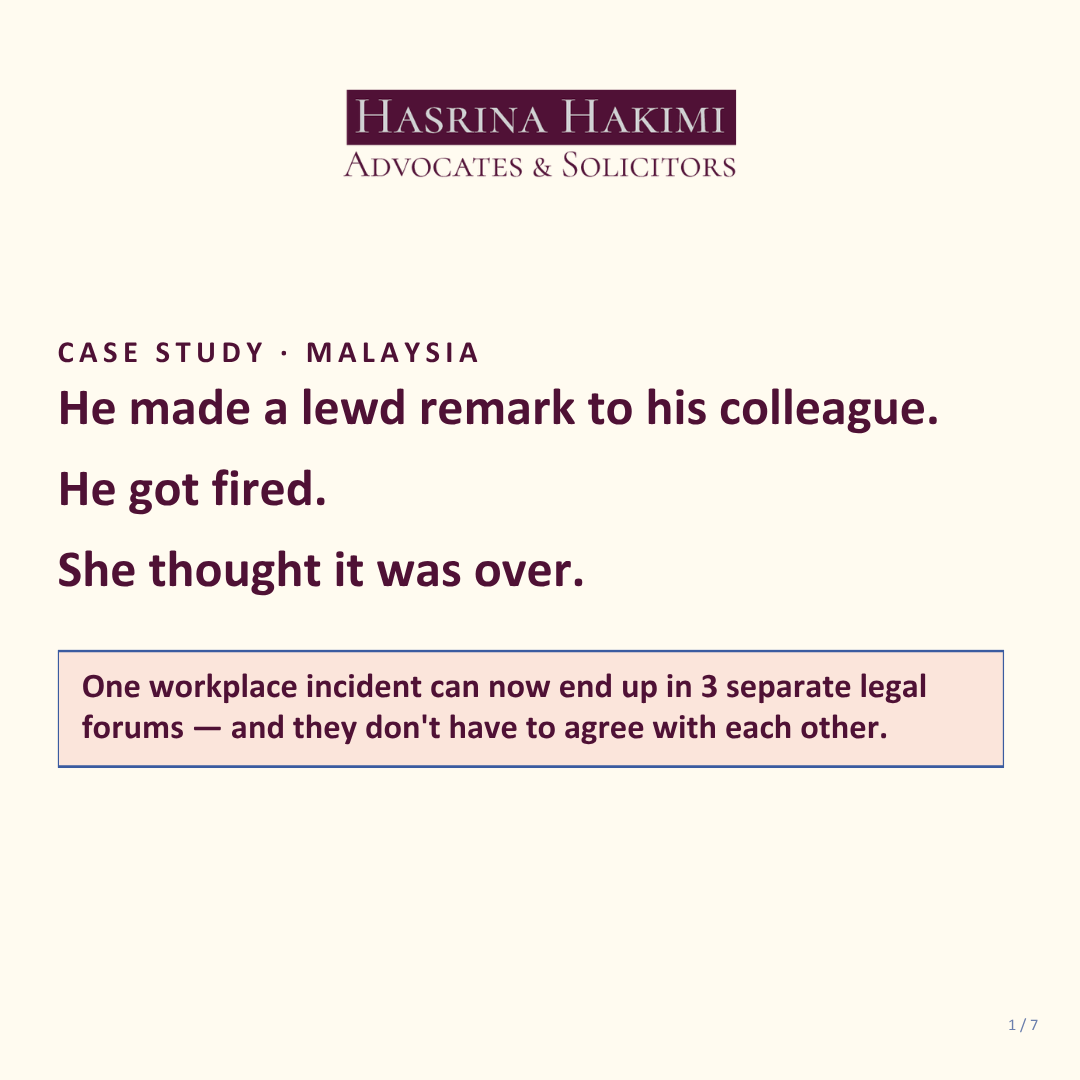
HE MADE A LEWD REMARK TO HIS COLLEAGUE. HE GOT FIRED. SHE THOUGHT IT WAS OVER.
Part 1: The Case of Wong Qi Sheng v. Eurofins GSC IT Malaysia & The Dual-Forum Dilemma
The Industrial Court decision in Wong Qi Sheng v. Eurofins GSC IT Malaysia Sdn Bhd serves as a landmark illustration of how sexual harassment in the Malaysian workplace is scrutinized under industrial law.
The dispute centered on an IT Engineer who was terminated for insubordination and sexual harassment after making a lewd comment to his single female Team Lead, insinuating that her COVID-19 infection was the consequence of her “making out”.
While the Industrial Court rigorously assessed witness credibility and upheld the dismissal—condemning the claimant’s evasive testimony and the inherently offensive, hostile nature of his sexual remark—the case laid bare a major structural challenge in Malaysian jurisprudence. Parallel to internal company disciplinary proceedings and a Labour Office complaint, workplace harassment disputes are now subject to the recently enacted Anti-Sexual Harassment Act 2022 (ASHA 2022).
The Institutional Gap: One Incident, Three Isolated Forums
With the establishment of the Tribunal for Anti-Sexual Harassment (TAGS), victims now have a dedicated, specialist statutory forum. However, this has created a fragmented landscape where the exact same factual incident can be adjudicated across three separate venues in total isolation:
- Internal Domestic Inquiry (Company): Focuses on internal policy breaches and disciplinary penalties up to summary dismissal.
- The Industrial Court (Section 20 IRA 1967): Focuses strictly on whether the termination of the alleged harasser was with “just cause or excuse”. The parties are strictly the Employer and the ex-Employee.
- The Anti-Sexual Harassment Tribunal (TAGS): Focuses directly on victim redress, statutory compensation (up to RM250,000), and formal apologies, involving solely the Victim and the Harasser.
The Nightmarish Risk of Irreconcilable Outcomes
Currently, there is no statutory cross-communication mechanism between TAGS and the Industrial Court. This structural disconnect creates alarming possibilities:
- Conflicting Findings: TAGS could find that no sexual harassment occurred, while the Industrial Court finds the dismissal justified based on the exact same words.
- The Reinstatement Paradox: TAGS could find the perpetrator guilty and order him to pay compensation to the victim, while the Industrial Court—finding procedural flaws in the domestic inquiry—orders the harasser reinstated to the company. The victim is then forced to return to work side-by-side with her perpetrator.
Part 2: The Plight of the Victim & The Need for Legal Integration
The party most severely disadvantaged by this jurisdictional fragmentation is the complainant:
- Lack of Locus Standi in the Industrial Court: In the Industrial Court, the victim is not a party. She has no standing to submit legal arguments or appeal an adverse decision; she is merely summoned as a witness. If the court orders reinstatement, only the employer can file for Judicial Review.
- Secondary Trauma & Reliving the Incident: Testifying in an internal inquiry, before TAGS, and again under cross-examination at the Industrial Court subjects victims to exhausting emotional fatigue.
Proposed Practical Reforms: Bridging the Institutional Divide
To prevent the Malaysian legal system from working against itself, three minimum reforms are vital:
- Mandatory Notification & Sharing: Both TAGS and the Industrial Court registries should establish formal cross-disclosure protocols to notify each other whenever parallel proceedings arise from the same incident.
- Sequencing & Stay of Proceedings: Since TAGS is statutorily mandated to deliver awards within 60 days (whereas Industrial Court trials typically span 12 to 24 months), the Industrial Court should hold its proceedings in abeyance until the specialist tribunal concludes its factual determination.
- Cross-Admissibility of Findings: Factual findings and evidence recorded before TAGS as a specialist statutory tribunal should be admissible as prima facie evidence in subsequent Industrial Court proceedings.
Conclusion
The Eurofins GSC IT Malaysia award demonstrates that Malaysian tribunals take sexual harassment seriously, rejecting evasive defenses and upholding swift termination for hostile remarks. However, the coexistence of TAGS and the Industrial Court requires urgent procedural synchronization. Until legislative bridges are built, employers, HR practitioners, and legal counsel must coordinate their evidence across all three forums to ensure workplace safety, protect victims from secondary trauma, and prevent contradictory judgments.
Acknowledgment: The author acknowledges the insightful analysis by Tahirah Manesah binti Abu Bakar on the Eurofins case, which contributed to the discussion in this article.
Disclaimer: This article is for informational purposes only and does not constitute formal legal advice. For corporate advisory on workplace harassment policies, Domestic Inquiries, or representation before TAGS and the Industrial Court, contact Hasrina Hakimi Advocates & Solicitors.