
2025
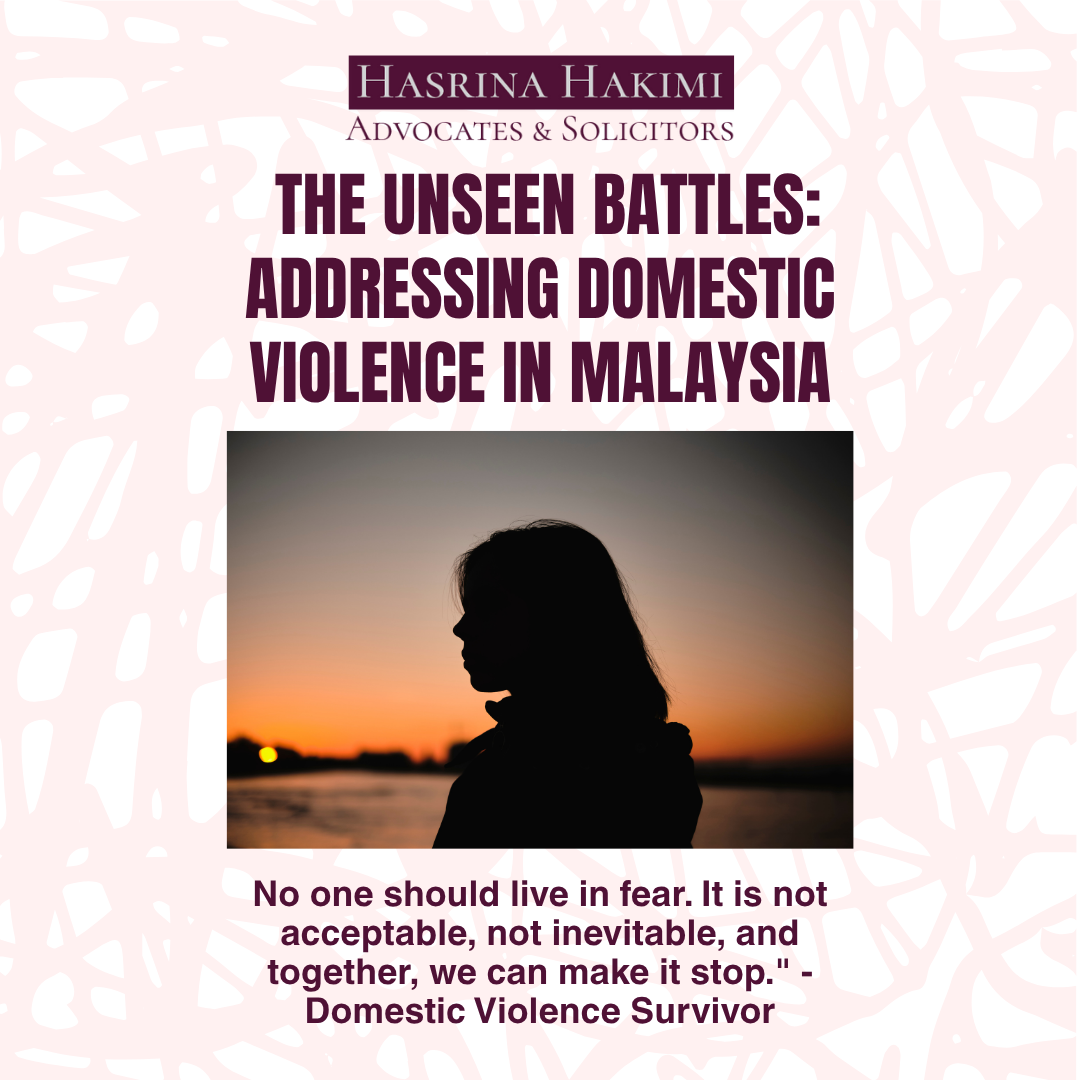
THE UNSEEN BATTLES: ADDRESSING DOMESTIC VIOLENCE IN MALAYSIA
admin@hasrina
September 3, 2026
THE UNSEEN BATTLES: ADDRESSING DOMESTIC VIOLENCE IN MALAYSIA
“No one should live in fear. It is not acceptable, not inevitable, and together, we can make it stop.”
— Domestic Violence Survivor
Domestic violence, often shrouded in silence and stigma, takes a devastating toll on individuals, children, and the broader fabric of society through its “unseen battles”.
Under Section 2 of the Domestic Violence Act 1994 (DVA 1994), domestic violence occurs when a person causes physical, sexual, emotional, psychological, or economic abuse. The DVA grants vital statutory protection to spouses, former spouses, children, incapacitated adults, and other family members residing together. (Note: The DVA does not apply to unmarried dating partners).
Malaysia has progressively strengthened its legal machinery to empower victims. If you or someone you know is experiencing domestic abuse, here are the essential legal recourses and protection orders available:
1. Imminent Danger: Emergency Protection Order (EPO)
When to use: When you need immediate physical protection from an abusive spouse due to imminent threat of harm.
- Issued by: A Social Welfare Officer (Pegawai Jabatan Kebajikan Masyarakat – JKM) at the nearest JKM office.
- Speed: Can be issued within hours, operating 24 hours a day.
- No Police Report Required: You are not required to lodge an advance police report to obtain an EPO.
- Validity: Operates for seven (7) days, providing crucial breathing room to secure temporary shelter and formalize police complaints.
2. During Police Investigation: Interim Protection Order (IPO)
When to use: After lodging a police report, while waiting for the police to investigate and the Public Prosecutor to initiate criminal charges.
- Issued by: The Magistrates’ Court upon application by the victim or welfare officer.
- Function: Restrains the perpetrator from committing any further acts of abuse, threats, or harassment while investigations are active.
3. Trial & Long-Term Protection: Protection Order (PO)
When to use: During criminal proceedings or formal court hearings where the abuser is being prosecuted.
- Duration: Provides long-term security for up to 12 months, and can be extended upon application.
- Broad Scope of Restraining Terms: Prohibiting the abuser from entering your residence, school, or workplace; granting you exclusive occupation of the shared matrimonial home; granting continued use of family vehicles; and facilitating police accompaniment to safely retrieve personal belongings.
Penalties for Violating Protection Orders (EPO / IPO / PO)
Breaching any protection order is a criminal offense under the DVA:
- Standard Violation: Fine up to RM2,000, imprisonment up to six (6) months, or both.
- Violation Involving Violence: Fine up to RM4,000, imprisonment up to six (6) months, or both.
- Subsequent / Repeat Violation: Mandatory imprisonment of not less than 72 hours and up to two (2) years, and a fine up to RM5,000.
Civil Tort Claims (Married Women Act 1957) & High Court Injunctions (Section 103 LRA)
Civil Damages under Married Women Act 1957
Beyond criminal prosecution, the Married Women Act 1957 expressly allows a spouse to institute a civil tort action against their abusive partner for assault, battery, psychiatric trauma, and property damage, enabling victims to claim financial compensation.
Matrimonial Injunctions During Divorce (Section 103 LRA 1976)
If you have filed a divorce petition in the High Court and your spouse continues to harass, stalk, or enter your home, the High Court is empowered under Section 103 of the Law Reform (Marriage and Divorce) Act 1976 (LRA) to issue an injunction restraining the spouse from “forcing his or her society” and from all acts of molestation.
Recent Authority: Liow Keng Luan v. Tan Si Hai [2024] CLJU 213
The High Court reiterated that “molestation” encompasses any act causing annoyance, disturbance, or emotional vexation. In deciding whether to order an exclusion injunction, the court evaluates:
The High Court reiterated that “molestation” encompasses any act causing annoyance, disturbance, or emotional vexation. In deciding whether to order an exclusion injunction, the court evaluates:
- The conduct and behavior of both parties;
- The psychological and physical effect on children if exclusion is or is not ordered;
- Alternative accommodation available to both parties; and
- The medical health and physical risk of injury to the victim.
Critical Action Checklist for Survivors
- Prioritise Safety: Seek immediate medical attention, relocate to a safe environment, or contact the Talian Kasih hotline at 15999.
- Document Everything: Retain photographs of injuries, hospital medical reports, audio/video recordings, and threatening text messages or call logs.
- Seek Experienced Legal Counsel: Engage legal advocates who can rapidly coordinate EPOs, file court protection applications, and structure comprehensive matrimonial divorce petitions.
Conclusion
Domestic violence is neither a private domestic matter nor something that anyone should suffer through in silence. The legal framework in Malaysia provides immediate, concrete mechanisms to protect your physical safety, your children, and your home. Reaching out for professional assistance is the vital first step toward restoring safety and peace of mind.
Disclaimer: This article is for informational purposes only and does not constitute formal legal advice. If you or your loved ones are experiencing domestic abuse, please reach out to Hasrina Hakimi Advocates & Solicitors for confidential, compassionate legal counsel.