


2026
WHEN A DEAL IS NO DEAL AT ALL: THE DOCTRINE OF ILLEGALITY IN MALAYSIAN CONTRACT LAW
admin@hasrina
September 4, 2026
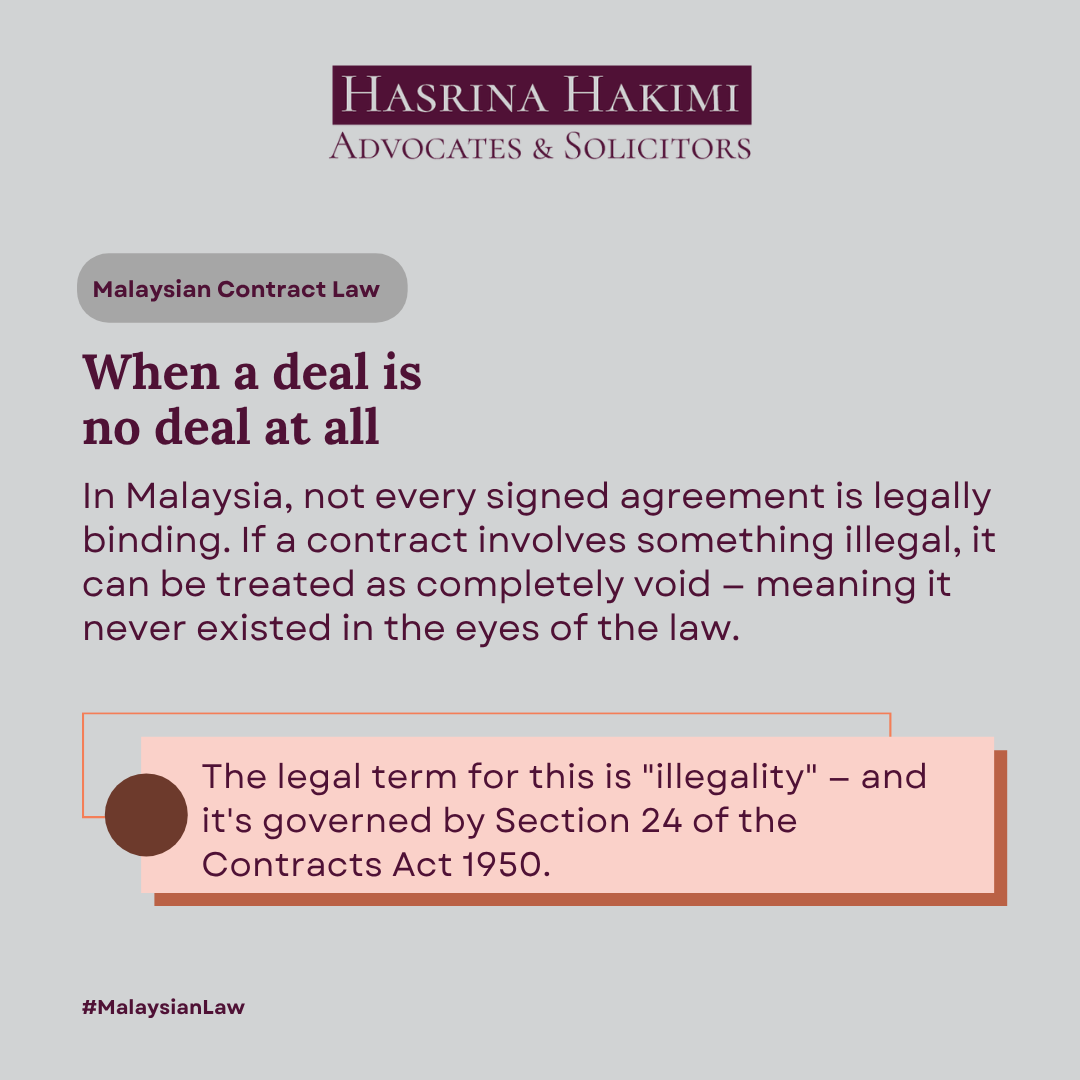
WHEN A DEAL IS NO DEAL AT ALL: THE DOCTRINE OF ILLEGALITY IN MALAYSIAN CONTRACT LAW
In commercial dealings, businesses often assume that once an agreement is signed, stamped, and exchanged, it is ironclad. In Malaysian law, however, not every signed contract is legally enforceable.
Under the doctrine of illegality, an agreement tainted by unlawfulness is treated as void ab initio—meaning that in the eyes of the law, the deal never existed and the courts will refuse to lend their assistance to enforce it. The statutory cornerstone of this doctrine is codified under Section 24 of the Contracts Act 1950 (CA 1950).
The Five Prohibited Limbs under Section 24 of the Contracts Act 1950
Section 24 provides that the consideration or object of an agreement is unlawful if:
- (a) It is forbidden by law;
- (b) It is of such a nature that, if permitted, it would defeat any law;
- (c) It is fraudulent;
- (d) It involves or implies injury to the person or property of another; or
- (e) The court regards it as immoral or opposed to public policy.
As confirmed by the Federal Court in Triple Zest Trading & Suppliers & Ors v. Applied Business Technologies Sdn Bhd [2023] 10 CLJ 187, once any of these five prohibited categories is engaged, the agreement is void in its entirety by statute, regardless of the commercial intentions of the contracting parties.
Statutory Illegality vs. Common Law Illegality
The legal distinction between statutory and common law illegality was authoritatively laid down by Harmindar Singh Dhaliwal JCA (as he then was) in the Court of Appeal decision of Pang Mun Chung & Anor v. Cheong Huey Charn [2018] 8 CLJ 663:
- Statutory Illegality: Arises directly from non-compliance with enacted legislation (limbs (a) and (b));
- Common Law Illegality: Grounded upon recognized heads of public policy, now codified under limb (e).
Apex Clarification – Detik Ria Sdn Bhd v. Prudential Corporation Holdings Ltd & Anor [2025] 4 CLJ 159 (Federal Court):
The Federal Court clarified that unlike English law (which has evolved through dynamic common law principles like Patel v Mirza), the determination of illegality in Malaysia remains fundamentally an exercise of statutory construction under Section 24 of the Contracts Act 1950.
The Federal Court clarified that unlike English law (which has evolved through dynamic common law principles like Patel v Mirza), the determination of illegality in Malaysia remains fundamentally an exercise of statutory construction under Section 24 of the Contracts Act 1950.
The Four Ways Illegality Infects a Contract
In the seminal decision of Yango Pastoral Co Pty Ltd & Ors v. First Chicago Aust Ltd & Ors [1978] 139 CLR 410, the court identified the four distinct modes through which illegality impairs contractual validity:
- Where the contract is expressly formed to do something that the statute forbids;
- Where the contract is of a type that the statute expressly or impliedly prohibits;
- Where the contract, although lawful on its face, was entered into for an unlawful purpose; and
- Where the contract, although lawful in its terms, is performed in a manner prohibited by statute.
Crucial Exception: Non-Compliance Does NOT Automatically Mean Illegality
A critical qualification in modern contract jurisprudence is that mere regulatory non-compliance does not automatically render an agreement void for illegality:
1. Liputan Simfoni Sdn Bhd v. Pembangunan Orkid Desa Sdn Bhd [2019] 1 CLJ 183 (Federal Court):
The Federal Court held that non-compliance with the Stamp Act 1949 or the Real Property Gains Tax Act 1976 does not render a Sale and Purchase Agreement illegal or void. The statutory purpose of revenue legislation is to penalize non-payment of taxes, not to strike down commercial contracts.
The Federal Court held that non-compliance with the Stamp Act 1949 or the Real Property Gains Tax Act 1976 does not render a Sale and Purchase Agreement illegal or void. The statutory purpose of revenue legislation is to penalize non-payment of taxes, not to strike down commercial contracts.
2. Golden Wheel Credit Sdn Bhd v. Dato’ Siah Teong Din [2025] 10 CLJ (Court of Appeal):
The Court of Appeal overturned a High Court decision that had struck down moneylending agreements for alleged non-compliance with the Moneylenders Act 1951. The appellate court ruled that because the Act did not expressly declare such agreements void, the transaction was not illegal, ordering full restitution of RM3,383,500.00 to the lender.
The Court of Appeal overturned a High Court decision that had struck down moneylending agreements for alleged non-compliance with the Moneylenders Act 1951. The appellate court ruled that because the Act did not expressly declare such agreements void, the transaction was not illegal, ordering full restitution of RM3,383,500.00 to the lender.
The Court’s Inherent Duty to Raise Illegality Ex Proprio Motu
A remarkable feature of the doctrine of illegality is that it does not depend on whether the parties plead it.
Duty of the Court: Pembinaan Jaya Zira Sdn Bhd v. Sungai Lui Construction & Development Sdn Bhd [2026] 3 CLJ:
The court reaffirmed that trial and appellate courts are legally duty-bound to raise illegality on their own motion (ex proprio motu), even if neither party raised the issue in their pleadings. No court may knowingly lend its assistance to enforce an illegal agreement (Keng Soon Finance Bhd v. MK Retnam Holdings [1989]; Merong Mahawangsa Sdn Bhd v. Dato’ Shazryl Eskay Abdullah [2015] 8 CLJ 212).
The court reaffirmed that trial and appellate courts are legally duty-bound to raise illegality on their own motion (ex proprio motu), even if neither party raised the issue in their pleadings. No court may knowingly lend its assistance to enforce an illegal agreement (Keng Soon Finance Bhd v. MK Retnam Holdings [1989]; Merong Mahawangsa Sdn Bhd v. Dato’ Shazryl Eskay Abdullah [2015] 8 CLJ 212).
Conclusion
The doctrine of illegality under Section 24 of the Contracts Act 1950 serves as an uncompromising boundary on contractual autonomy. Contracting parties cannot contract out of the law, and agreements tainted by unlawful purpose or consideration will be dismantled by the courts. However, distinguishing between statutory nullity and mere technical non-compliance requires rigorous legal analysis. Ensuring contracts are thoroughly audited for statutory compliance before execution is the only sure way to protect commercial transactions from becoming “a deal that is no deal at all.”
Disclaimer: This article is for informational purposes only and does not constitute formal legal advice. For advice regarding contractual drafting, statutory compliance, or commercial contract disputes, please contact Hasrina Hakimi Advocates & Solicitors.